

When engineers, designers, and purchasing teams need a custom gasket, seal, pad, insulator, or other precision component, one of the first questions is:
What materials can be die cut?
The answer is: a wide variety of materials can be die cut, including rubber, silicone, foam, plastics, films, fabrics, felt, cork, paper, composites, gasket materials, adhesive-backed materials, and many other sheet or flexible materials.
However, not every material is best suited to the same cutting process. Material type, thickness, hardness, part geometry, tolerance requirements, production quantity, and the intended application all play a role in determining the best manufacturing method.
At Mag-Knight Die Cutting, we work with a wide range of materials and can help determine whether die cutting, laser cutting, or another process is appropriate for your part.
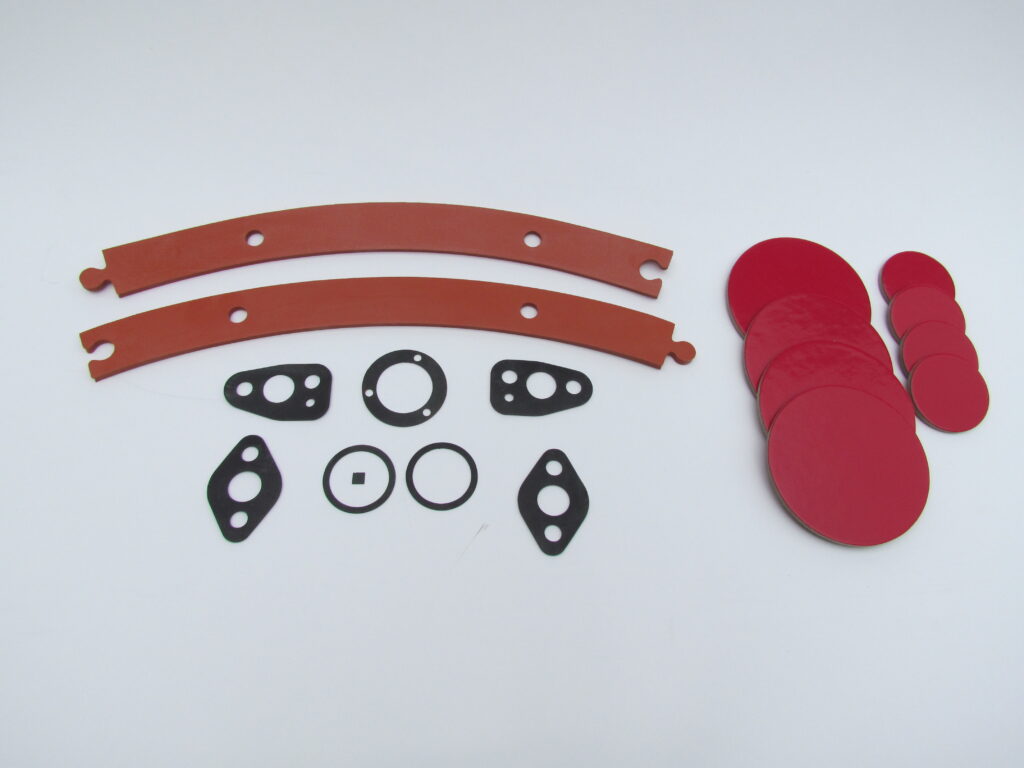
Common Materials That Can Be Die Cut
Here are some of the most common material categories used for custom die-cut parts.
Rubber
Rubber is one of the most common materials used for die-cut components. It can be converted into custom gaskets, seals, washers, pads, vibration isolators, and other industrial parts.
Common die-cut rubber materials include:
- EPDM
- Neoprene
- Buna-N / Nitrile
- Silicone
- SBR
- Butyl rubber
- Viton® / FKM
- Natural rubber
- Hypalon®
- Other specialty rubber compounds
The best rubber depends on the environment in which the finished part will be used. Temperature, chemicals, oil, water, ozone, compression, and other operating conditions may all affect material selection.
For custom gasket applications, see our Custom Gasket Cutting Services.
[IMAGE PLACEHOLDER — Close-up of custom die-cut rubber gaskets]
Foam
Foam materials are also excellent candidates for die cutting.
Common examples include:
- EVA foam
- Polyurethane foam
- Closed-cell foam
- Open-cell foam
- Neoprene foam
- Sponge rubber
- Foam gasket materials
- Adhesive-backed foam
Die-cut foam is commonly used for seals, gaskets, cushioning, insulation, vibration control, spacers, pads, and protective components.
The density, thickness, flexibility, and cell structure of the foam can affect how it should be processed.
[IMAGE PLACEHOLDER — Assortment of die-cut foam pads and gaskets]
Plastics and Plastic Films
Many plastics can be die cut, particularly when they are available in sheet or film form.
Examples include:
- Polycarbonate
- Lexan®
- Polypropylene
- Polyethylene
- HDPE
- LDPE
- PVC
- Polyester
- ABS
- Acrylic
- Polyurethane
- Vinyl
- UHMW
- PTFE / Teflon®
The type and thickness of the plastic are important when determining the appropriate cutting method.
Thin plastic films may be excellent candidates for steel-rule die cutting, while thicker or harder plastics may be better suited to laser cutting or another process.
See our Materials Guide for more information about materials and the processes used to cut them.
[IMAGE PLACEHOLDER — Various custom die-cut plastic components]
Silicone
Yes, silicone can be die cut.
Silicone sheet is commonly used for:
- Gaskets
- Seals
- Washers
- Pads
- Insulators
- Temperature-resistant components
- Industrial sealing applications
Silicone is available in different thicknesses and hardnesses, so the material specification should be matched to the application.
If you need a custom silicone gasket or seal, see our Gasket Cutting Services or request a quote.
[IMAGE PLACEHOLDER — Custom die-cut silicone gaskets]
EPDM, Neoprene and Other Gasket Materials
Gasket applications often require materials selected for specific environmental conditions.
Depending on the application, die-cut gasket materials may need to resist:
- Oil
- Water
- Chemicals
- Heat
- Ozone
- Weathering
- Compression
- Vibration
- Pressure
Common gasket materials include EPDM, neoprene, silicone, Buna-N/Nitrile, Viton®/FKM, Hypalon®, compressed non-asbestos materials, and other specialty gasket materials.
Choosing the right gasket material is about more than simply finding something that can be cut. The material must also perform properly in the finished application.
Fabrics and Textiles
Many fabrics and textile materials can be die cut into precise, repeatable shapes.
Examples include:
- Felt
- Cotton
- Canvas
- Polyester
- Flannel
- Wool
- Muslin
- Burlap
- Vinyl
- Leather
- Hook-and-loop materials
Die-cut fabrics may be used for insulation, filtration, seals, protective components, pads, spacers, and other industrial applications.
The construction and thickness of the fabric can affect the cutting process and achievable tolerances.
Felt
Felt is commonly used for seals, washers, filters, insulation, anti-scratch pads, vibration control, and spacers.
Depending on its composition and density, felt can be die cut into simple or relatively intricate shapes.
Cork
Cork can be die cut into gaskets, washers, seals, pads, spacers, and insulating components.
Cork’s compressibility and other physical properties make it useful in certain sealing and industrial applications.
Paper, Cardboard and Other Sheet Materials
Die cutting is widely used with paper-based and fiber-based materials.
Examples include:
- Paper
- Paperboard
- Chipboard
- Cellulose
- Corrugated cardboard
- Corrugated plastic
- Other fiber-based sheet materials
These materials can be used for gaskets, spacers, insulation, templates, packaging components, and other applications.
Composites and Fiberglass
Some composite materials can be die cut, while others may require laser cutting or another manufacturing process.
Examples include:
- Fiberglass
- Carbon fiber
- Carbon fiber prepreg
- Aramid
- Kevlar®
- Composite sheet materials
Material construction and thickness are particularly important when determining the appropriate cutting process.
Magnetic Materials
Flexible magnetic sheet can be die cut into custom shapes for applications such as:
- Magnetic seals
- Labels
- Displays
- Flexible components
- Gaskets
- Custom promotional products
Adhesive-Backed Materials
Adhesive-backed materials are particularly useful when a finished component needs to be both cut to shape and applied to another surface.
Examples include:
- Pressure-sensitive adhesive
- Double-sided adhesive
- Adhesive-backed foam
- Adhesive-backed rubber
- Adhesive-backed plastic film
- Transfer adhesive
These materials can be converted into gaskets, mounting pads, insulation, seals, spacers, labels, and protective films.
Can Any Material Be Die Cut?
No.
This is an important distinction.
A material may be cuttable without being a good candidate for conventional die cutting.
Material hardness, thickness, flexibility, part geometry, production quantity, and required tolerance all affect process selection.
For example, a thin flexible plastic film may be an excellent candidate for steel-rule die cutting, while a thick or rigid plastic may be better suited to laser cutting.
That’s why we evaluate the material and the part together, rather than simply asking whether a particular material can be cut.
If you have a material you’re unsure about, our Materials Guide provides additional information.
How Does Material Thickness Affect Die Cutting?
Thickness is one of the most important considerations when evaluating a material.
A material that cuts easily at one thickness may behave very differently at another.
Thickness can affect:
- Cutting force
- Tool selection
- Part tolerances
- Edge quality
- Small features
- Minimum hole size
- Material handling
- Production speed
The material’s hardness and flexibility are also important. Two materials with the same thickness can behave very differently during the cutting process.
Does Material Hardness Matter?
Yes.
Soft, flexible materials such as rubber and foam behave differently from harder plastics, composites, and other sheet materials.
Hardness can affect the cutting force required, edge quality, tooling, part geometry, and the best manufacturing process.
For this reason, providing the exact material specification and thickness when requesting a quote is helpful.
What About Small Holes and Complex Shapes?
Part geometry matters just as much as the material.
Small holes, narrow sections, tight spacing, sharp corners, and intricate shapes can affect tooling and production requirements.
A part may be easy to cut in one material but difficult to manufacture in another.
If you have a drawing, CAD file, or sample part, we can evaluate the geometry along with the material requirements.
Die Cutting vs. Laser Cutting
One of the most common questions we receive is whether a part should be die cut or laser cut.
Neither process is automatically better for every application.
Die cutting is often a good choice when:
- You are producing repeat quantities
- The material is flexible or compressible
- The part geometry is established
- You need consistent production
- You are producing gaskets, seals, pads, or similar components
- Production volume justifies tooling
Laser cutting can be useful when:
- You are producing prototypes
- Quantities are relatively low
- The design changes frequently
- The material or geometry is difficult to die cut
- You want to avoid dedicated tooling for an initial run
Mag-Knight provides both custom die cutting and laser cutting, allowing the process to be selected based on the actual requirements of the part.
[IMAGE PLACEHOLDER — Side-by-side example of laser-cut and die-cut parts]
How Do I Choose the Right Material?
The best material isn’t necessarily the easiest material to cut.
Start with the requirements of the finished component.
Ask:
- What temperature will the part see?
- Will it contact oil, fuel, water, or chemicals?
- Does it need to seal?
- Does it need to compress?
- Does it need to be flexible?
- Does it need to provide electrical insulation?
- Does it need to resist abrasion?
- Does it need to withstand outdoor exposure?
- What thickness is required?
- What quantity will be produced?
Once those requirements are known, the material and manufacturing process can be evaluated together.
If you’re not sure which material to specify, tell us what the part needs to do. That information can be just as useful as knowing the material name.
What Information Do I Need for a Die-Cutting Quote?
The more information you provide, the easier it is to determine the appropriate material, process, tooling, and pricing.
For a quote, it’s helpful to provide:
- Material type
- Material thickness
- Part dimensions
- Quantity
- Required tolerances
- Application
- Drawing or CAD file
- Adhesive requirements
- Temperature requirements
- Chemical exposure
- Special surface requirements
- Prototype or production requirements
If you have an existing part but don’t have a drawing, a sample may also be useful.
You can request a quotation from Mag-Knight and submit your part information and drawing.
What File Types Can I Send?
If you have a drawing, CAD file, or other representation of the part, send it with your RFQ.
Our quotation page provides information about submitting drawings and currently lists file formats including PDF, DXF, AI, JPG, and DWG.
If you don’t have a CAD drawing, contact us and let us know what you have.
What If I Don’t Know Which Material to Use?
That’s not unusual.
If you know the application requirements but aren’t sure which material is appropriate, provide as much information as possible about how the part will be used.
For example:
“I need a gasket that will seal oil at elevated temperature.”
Or:
“I need a compressible pad to isolate vibration.”
Or:
“I need a thin plastic insulator with adhesive on one side.”
Those requirements can help determine which materials and manufacturing processes should be considered.
Explore Die-Cutting Materials
Mag-Knight works with a broad range of materials for custom die-cutting applications.
For the most complete list, visit our Die Cutting Materials Guide.
If you’re not sure whether your particular material can be processed, don’t guess. Send us the material specification, drawing, sample, or application requirements and we’ll help determine the appropriate manufacturing approach.
Frequently Asked Questions
What materials can be die cut?
Many sheet and flexible materials can be die cut, including rubber, silicone, EPDM, neoprene, foam, plastics, films, fabrics, felt, cork, paper, composites, gasket materials, and adhesive-backed materials. The suitability of a specific material depends on its thickness, hardness, geometry, and application.
Can rubber be die cut?
Yes. Rubber is one of the most common materials used for custom die-cut parts, including gaskets, seals, washers, pads, and vibration-control components.
Can silicone be die cut?
Yes. Silicone sheet can be die cut into gaskets, seals, washers, pads, and other custom components.
Can foam be die cut?
Yes. Many types of foam can be die cut, including EVA, polyurethane, closed-cell foam, sponge rubber, and foam gasket materials.
Can plastic be die cut?
Yes. Many plastics and plastic films can be die cut. The type and thickness of the plastic are important factors when selecting the manufacturing process.
Can EPDM be die cut?
Yes. EPDM is commonly used for die-cut gaskets and seals. The specific material specification and part requirements should be evaluated before production.
Can neoprene be die cut?
Yes. Neoprene can be die cut into gaskets, seals, pads, insulation, and other custom components.
Can Viton® be die cut?
Yes. Viton®/FKM sheet can be die cut for seals and gaskets where chemical and temperature resistance are important considerations.
Can adhesive-backed materials be die cut?
Yes. Adhesive-backed foam, rubber, plastic films, transfer adhesives, and other pressure-sensitive materials can often be converted into custom shapes.
Can thin metal be die cut?
Some thin metals and shim materials can be processed using appropriate cutting methods. Depending on the material, thickness, and geometry, laser or plasma cutting may be a better option.
Is every material suitable for steel-rule die cutting?
No. Material thickness, hardness, flexibility, geometry, and production requirements all affect whether steel-rule die cutting is appropriate.
How thick can a material be for die cutting?
There isn’t one maximum thickness that applies to every material. The practical limit depends on the material, hardness, density, geometry, tooling, and equipment.
How do I know which material is right for my part?
Start with the application requirements, including temperature, chemicals, compression, flexibility, electrical requirements, abrasion, and environmental exposure. These requirements can then be used to identify appropriate materials.
Can you make a die-cut part from a sample?
In many cases, an existing sample can provide useful information for developing a replacement or custom part. Contact us to discuss your sample and requirements.
Need Help Choosing a Die-Cutting Material?
If you’re trying to determine what material to use, whether your material can be die cut, or whether die cutting or laser cutting is the better process, we’d be happy to take a look.
Send us your drawing, material specification, sample, or simply describe what the part needs to do.
Request a Quote from Mag-Knight →
Or start with our complete Die Cutting Materials Guide →.
[IMAGE PLACEHOLDER — Best quality photo of Mag-Knight finished custom die-cut parts]
About Mag-Knight Die Cutting
Mag-Knight Die Cutting is a family-owned custom manufacturing company specializing in die cutting, gaskets, laser cutting, and other custom-cut components. We work with a wide range of materials and applications and help customers determine the most appropriate manufacturing process for their parts.