

The Short Answer
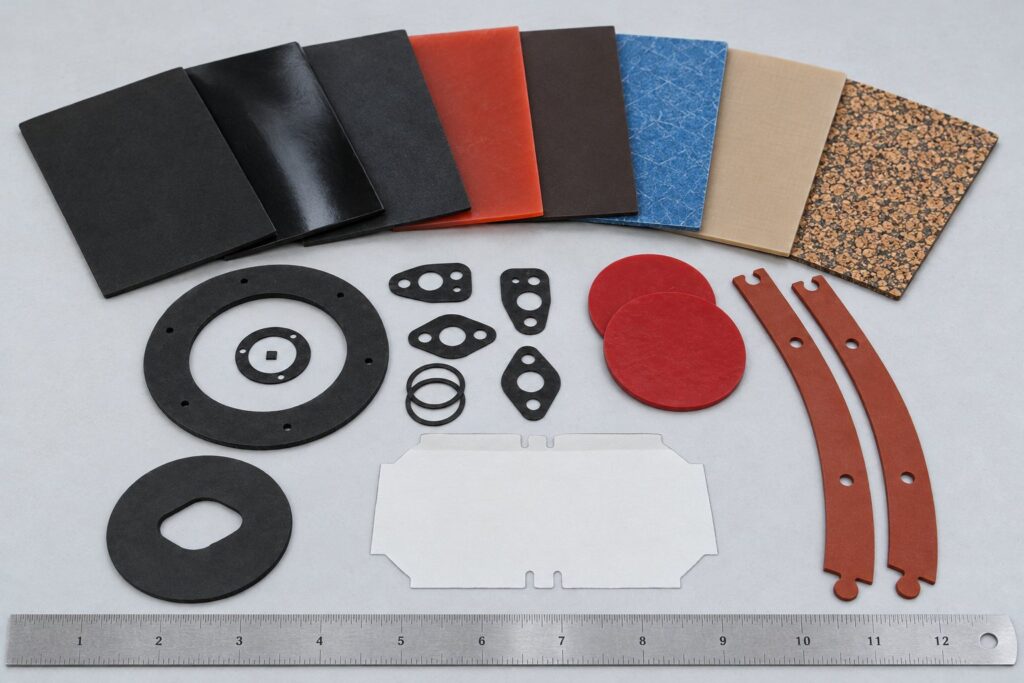
Choose a gasket material by the fluid first, then temperature, then pressure. Oil or fuel: nitrile (Buna-N), or Viton® when it is hot. Water, steam or outdoors: EPDM. Extreme heat or cold, or food contact: silicone. Weather plus some oil: neoprene. Pipe flanges with higher pressure: compressed fiber. Aggressive chemicals: PTFE.
Then compare prices for free, instantly. Our Instant Gasket Pricing tool lets you price the same gasket in different materials in a minute: change the material and the price updates in seconds.
Gasket Material Comparison Chart
| Material | Typical temperature range | Good with | Avoid |
|---|---|---|---|
| Neoprene (CR) | −40°F to 250°F | Weather, ozone, refrigerants, moderate oils | Aromatic and chlorinated solvents, ketones |
| Nitrile / Buna-N (NBR) | −30°F to 212°F (some grades to 250°F) | Petroleum oils, fuels, hydraulic fluid, water | Sunlight and ozone, ketones, brake fluid |
| EPDM | −60°F to 300°F | Water, steam, glycol coolant, outdoor exposure, dilute acids and alkalis | Petroleum oils and fuels |
| Silicone (VMQ) | −65°F to 400°F | Dry heat, cold, ozone, food contact (FDA grades) | Fuels, oils, steam, abrasion |
| Viton® (FKM) | −15°F to 400°F | Hot oils, fuels, aromatics, many acids | Hot water and steam, ketones, amines, brake fluid |
| Red rubber (SBR) | About −20°F to 180°F (check the sheet’s data sheet) | Water, air, low-pressure general sealing | Oils, fuels, solvents |
| Compressed fiber (Garlock Blue-Gard® 3000, aramid/NBR) | −100°F to 400°F continuous (700°F maximum); up to 1,000 psi | Water, oils, gasoline, aliphatic hydrocarbons in bolted flanges | Strong acids and alkalis |
| PTFE (Garlock Gylon® 3500) | −450°F to 500°F; up to 1,200 psi | Strong acids (except hydrofluoric), solvents, hydrocarbons, steam, chlorine | Very low bolt loads; soft, uneven flanges |
| Cork-nitrile | −4°F to 250°F; low pressure | Oils and fuels at low bolt load, uneven covers | Aromatic solvents, strong acids, steam |
What Each Material Costs
We priced the same part in every material with our free instant estimator: a 3″ × 3″ gasket, 1/16″ thick, with four 1/4″ bolt holes. The die cost is the same for every material ($230–$300 at 500 pieces). Only the material changes the per-part price.
| Material | 100 pieces | 500 pieces | 1,000 pieces |
|---|---|---|---|
| Red rubber (SBR) | $2.85–$3.85 | $1.50–$2.05 | $1.15–$1.55 |
| Cork-nitrile | $2.90–$3.95 | $1.65–$2.20 | $1.25–$1.70 |
| EPDM, 60 durometer | $3.05–$4.10 | $1.70–$2.25 | $1.30–$1.80 |
| Nitrile (Buna-N), 60 durometer | $3.05–$4.15 | $1.70–$2.30 | $1.35–$1.80 |
| Neoprene, 60 durometer | $3.20–$4.35 | $1.75–$2.35 | $1.35–$1.85 |
| Red silicone, 60 durometer | $3.15–$4.25 | $2.10–$2.85 | $1.70–$2.35 |
| White FDA silicone | $3.70–$5.00 | $2.35–$3.20 | $1.95–$2.65 |
| Garlock Blue-Gard® 3000 | $3.40–$4.60 | $2.40–$3.25 | $1.90–$2.60 |
| Viton® (FKM), 75 durometer | $5.25–$7.10 | $4.40–$5.95 | $4.20–$5.70 |
| Garlock Gylon® 3500 PTFE | $16.50–$22.50 | $13.00–$17.50 | $12.00–$16.50 |
The common rubbers (SBR, cork-nitrile, EPDM, nitrile and neoprene) all land within about 30¢ of each other at 500 pieces. That means you should choose among them on performance, not price. Viton® costs about 2½ times as much, and PTFE about 7 times as much, so use them only where the fluid or temperature calls for them.
How to Choose: Five Questions
1. What will the gasket touch?
This rules out the most materials. EPDM is excellent in water and steam but fails in oil. Nitrile is the opposite. If you are not sure what the fluid is, send us the application and we will recommend a material.
2. How hot or cold does it get?
Use the continuous temperature, not a brief peak. Neoprene, nitrile and SBR suit most room-temperature and engine-bay jobs. Above about 250°F, look at EPDM (in water), silicone (in dry heat), Viton® (in hot oil), compressed fiber or PTFE.
3. How much pressure and bolt load?
Soft rubber and cork seal at low bolt loads on thin covers and uneven surfaces. Bolted pipe flanges at higher pressure need compressed fiber or PTFE, which resist being squeezed out of the joint.
4. How hard should it be?
We stock most rubbers from 40 to 75 durometer. Softer (40–50) conforms to rough or warped surfaces at low bolt load. Medium (60) is the general-purpose choice. Firmer (70–75) resists extrusion and holds tighter dimensions.
5. Do you need a certification?
For food and beverage parts we stock white FDA-compliant silicone, EPDM and nitrile. For drinking-water systems we stock NSF-61 certified EPDM, Santoprene™ and Garlock Multi-Swell™ 3760-U. Tell us the certification and we will confirm it on your quote.
Price Your Gasket in Every Material, Free
The fastest way to decide is to see the numbers. With our free Instant Gasket Pricing tool:
- Upload your DXF or PDF, or enter simple dimensions.
- Choose a material family, then a specific material and thickness. There are 418 gasket options.
- Enter up to four quantities and get an instant price.
- Change the material and price it again. Each new price comes back in seconds.
Every estimate is nonbinding. Before we build your die, I review your drawing and material choice personally at no charge, and I will tell you if a different material would seal better or cost less.
For tolerances, lead times and design tips, see our complete guide to die-cut gaskets. All the materials we cut are listed on the materials page.
Frequently Asked Questions
What is the best gasket material for oil?
Nitrile (Buna-N) is the standard choice for petroleum oils, fuels and hydraulic fluid up to about 212°F. For hot oil above about 250°F, Viton® (FKM) is the usual upgrade. Cork-nitrile works for oil covers with low bolt load.
What is the best gasket material for water and steam?
EPDM is the usual choice for water, steam, glycol coolant and outdoor exposure, typically up to about 300°F. Do not use EPDM with petroleum oils or fuels. For bolted steam flanges, compressed fiber or PTFE gasket sheet is common.
What gasket material handles the highest temperature?
Among common rubbers, silicone and Viton® handle about 400°F continuous. PTFE such as Garlock Gylon® 3500 is rated to 500°F. Ceramic felt is used above 2000°F, for example between fuel cells.
What is the difference between neoprene and EPDM gaskets?
Both resist weather and ozone. EPDM is better in water, steam and higher temperatures but fails in oil. Neoprene tolerates moderate oils and refrigerants but is less suited to steam.
Which gasket materials are FDA compliant?
Mag-Knight stocks white FDA-compliant silicone, EPDM and nitrile rubber. Garlock Gylon® 3500 PTFE also conforms to FDA regulations.
How much more does a Viton gasket cost than neoprene?
In our free instant estimator, a 3 inch square, 1/16 inch gasket at 500 pieces costs about $1.75–$2.35 in neoprene and $4.40–$5.95 in Viton®, or roughly 2½ times as much.
Can I compare gasket material prices online for free?
Yes. Mag-Knight’s Instant Gasket Pricing tool is free. Upload a drawing, choose any of 418 gasket materials and change the material to compare prices in seconds.

Pingback: Die-Cut Gaskets: Materials, Tolerances & Cost + Free Instant Price | Mag-Knight