Daniel B. Wolanski is the founder and president of Mag-Knight Inc., a contract die-cutting manufacturer in Snohomish, Washington, since 1993. He holds a B.S. in Mechanical Engineering from Michigan State University and spent nearly a decade (1987–1996) as an aerospace design engineer at Boeing. He is the sole inventor of U.S. Patent 5,511,822 and personally reviews incoming drawings for manufacturability.
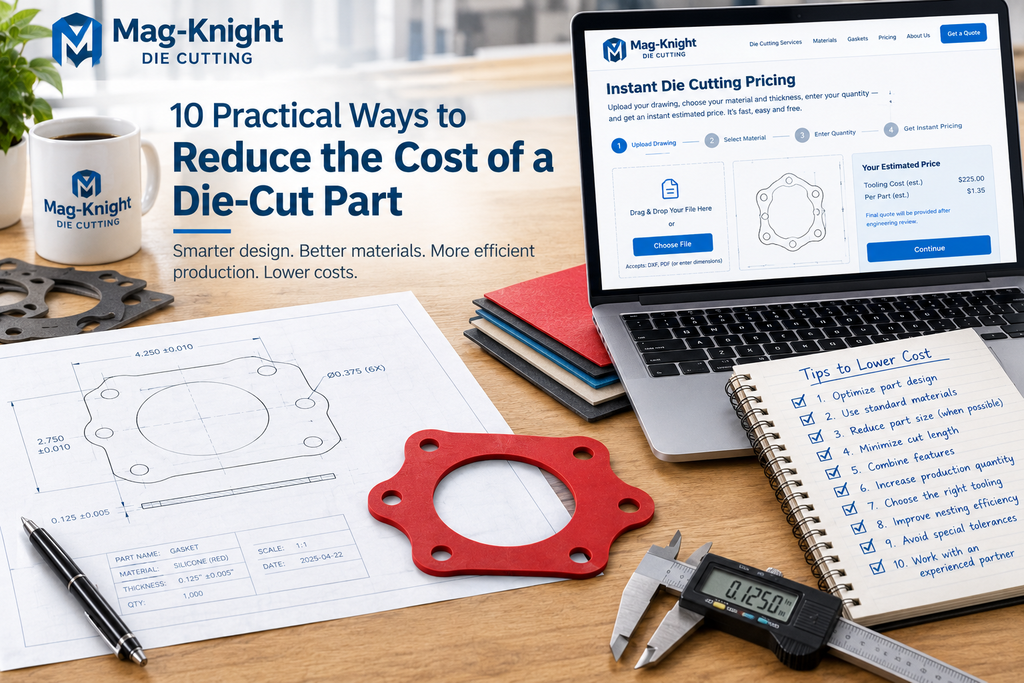
The fastest ways to lower the cost of a die-cut part are to order larger quantities, loosen tolerances where function allows, choose a similar but less expensive material, simplify the part so it cuts more easily, and consolidate your orders under a standing yearly PO. Most parts can improve on two or three of these at once, and the savings stack. Below are the ten levers we see make the biggest difference at Mag-Knight, with the reasoning behind each so you can decide which fit your part.
1. Order Larger Quantities
Tooling and setup are fixed costs, so the more parts you spread them across, the less each part carries. A $200 die spread across 100 parts adds $2.00 to every part. Spread across 1,000 parts, it adds $0.20, and across 10,000 parts, $0.02. Press time works the same way, since a longer run keeps the press cutting continuously instead of stopping for changeovers. If you know your annual usage, ordering closer to that number in fewer releases is usually the single biggest price lever you have. See our cost breakdown for how die cost and production cost combine into a per-part price.
2. Loosen Tolerances Where Function Allows
Standard die-cutting tolerances are tighter than many parts actually need. When a drawing calls for tolerances tighter than standard, we may need to perform SPC (statistical process control), which means measuring parts during the run and charting the results. That inspection time is real cost. If a dimension doesn’t affect fit or function, loosen it, and apply tight tolerances only to the features that truly need them. Our engineering library has more on which tolerances are realistic for different materials.
3. Choose a Similar but Less Expensive Material
Material is often the largest line item on a part, and many applications are specified with a more expensive material than the job requires. If your gasket sees moderate temperatures and light compression, a lower-cost rubber or foam grade may perform identically to the premium one on your drawing. Check the temperature, chemical, and compression requirements, then compare alternatives. The instant pricing tool makes this easy, since you can price the same part in several materials in seconds and see the difference side by side. Our suitable materials page lists what we regularly run.
4. Make the Part Easier to Cut
Parts with less detail cost less to tool and run. A few design habits make a real difference:
Keep holes away from edges. Holes placed too close to an edge are hard to cut cleanly and can distort the part. Give them room.
Avoid closely spaced parallel lines. Narrow webs between cut lines are fragile in both the die and the part.
Respect bend radius limits. Softer materials cut with thin rule can hold a bend radius around 1/16″, while harder materials need thicker rule with a minimum radius of 3/32″. Designing to these limits avoids a die that is expensive to build or wears faster.
Reduce unnecessary detail. Every extra feature adds bending, setup, and potential for scrap.
The instant pricing tool flags hard-to-cut features right on your drawing, so you can fix them before requesting a quote.
5. Place a Standing Yearly PO
If you use the same part throughout the year, a standing PO that you fulfill with scheduled releases lets us plan material purchases and press time around your demand instead of treating each order as a one-off. You get the volume benefit of a larger commitment without taking delivery of everything at once. Ask us about structuring one through our quotation page.
6. Standardize on Stocked Materials and Thicknesses
Materials we run regularly are easier to source and cut than specialty items. Where your design has flexibility, choosing a common thickness and material grade over an unusual one can reduce both material cost and lead time.
7. Use Material Efficiently
How parts sit on a sheet affects how much material is scrap. Simple, compact shapes nest well, and slight changes to a part’s outline can sometimes allow noticeably better yield. If you’re flexible on a dimension, ask whether adjusting it would improve material utilization.
8. Consolidate Similar Parts
If you order several parts that are close variants of each other, ask whether one design could serve more than one application, or whether related parts could share a die layout. Fewer unique parts means fewer dies and fewer setups.
9. Keep Your Existing Die and Avoid Revisions
When Mag-Knight builds your die, you own it and we store it in-house for future orders, so reorders don’t carry tooling cost again. Design changes after the die is built can mean modifying or replacing it, so finalize the design before tooling. If the design may still change, rapid prototyping with laser cutting lets you validate the part first. Our laser vs. die cutting comparison explains when each process makes sense.
10. Supply Your Own Material
If you already buy material at a better price, or have inventory on hand, you can supply it. Tell us when you request pricing and we’ll build the estimate around your material.
Cost Levers at a Glance
Lever
What to Change
Typical Impact
Quantity
Order more per release, or consolidate releases
High
Standing yearly PO
Commit annual volume with scheduled releases
High
Material choice
Switch to a similar, lower-cost material
High
Tolerances
Loosen where function allows, avoiding SPC
Medium to High
Part geometry
Fewer details, holes off edges, no tight parallel lines
Medium
Customer-supplied material
Provide your own stock
Medium
Material yield
Adjust shape or size for better nesting
Low to Medium
Part consolidation
Fewer unique parts and dies
Low to Medium
Impact is general guidance. The size of the savings depends on your part, material, and volume.
See the Difference Before You Commit
The easiest way to test these ideas is to price your part more than once. Upload your drawing to the instant pricing tool, then change one variable at a time, such as material or quantity, and watch the estimate move. When you’re ready for a firm number, request a quotation and our engineers will review the part and suggest further savings, from custom die cutting design tweaks to gasket material swaps.
Frequently Asked Questions
What is the biggest factor in die-cut part cost? For most parts it’s quantity and material. Larger quantities spread fixed tooling and setup across more parts, and material is often the largest direct cost on the part.
Does loosening tolerances really lower the price? Yes. Tolerances tighter than standard can require SPC (statistical process control) inspection during the run, which adds time and cost. Loosening tolerances on non-critical dimensions avoids that.
How can I lower cost without changing the material? Increase quantity, simplify the part geometry, keep holes away from edges, avoid closely spaced parallel lines, and consider a standing yearly PO with scheduled releases.
What is a standing yearly PO? It’s a purchase order covering your expected annual usage that you fulfill with scheduled releases throughout the year. It gives you volume pricing benefits without taking delivery of everything at once.
Why do holes near the edge increase cost? Holes placed too close to an edge are harder to cut cleanly and can distort the part, which increases scrap and die wear. Moving them inward makes the part easier and cheaper to cut.
Can I supply my own material to save money? Yes. If you have a better source or existing inventory, tell us when you request pricing and we’ll build the estimate around it.
How do I see how a design change affects price? Use the free instant pricing tool. Upload your drawing, change the material or quantity, and compare estimates immediately.
Want help trimming cost on a specific part? Request a quote with your drawing, or reach out through our contact page and our engineering team will suggest where to save.
If you’ve ever sent a die-cut part drawing to a vendor and waited two or three days just to find out whether it’s even in a reasonable price range, that’s not unusual, it’s the norm for this industry. Here’s why that delay exists, and how to get a real budget number in seconds instead, using Mag-Knight’s instant pricing tool as an example of the alternative.
Why Die Cutting Pricing Traditionally Takes So Long
Die-cut part pricing depends on several things that aren’t obvious from a part drawing alone: tooling complexity, material hardness, feature count, and production volume all interact to set the final number. Most shops handle that by having a person manually review every drawing before quoting, which means your request sits in a queue behind everyone else’s until someone has time to look at it. That’s a reasonable process, but it means a simple budget question like “is this part going to cost $0.20 or $2.00 each” often takes as long to answer as a fully firm quote would.
The result is that engineers evaluating die cutting early in a project, before they’re ready to commit to a vendor, often can’t get even a rough number without starting a sales conversation they’re not ready for yet.
What Changed
Mag-Knight built a free instant pricing tool that answers the budget question immediately, without waiting on a person’s schedule. You upload a DXF or PDF drawing, pick a material and thickness from hundreds of combinations (or tell us you’re supplying your own), and get price ranges per part and tooling cost across several quantities back in seconds. If something in your design would be hard to cut, like a hole placed too close to an edge, it gets flagged right on the drawing before you’ve spent any time on it.
This isn’t a replacement for a formal quote. Every estimate that moves forward is still reviewed by Mag-Knight’s engineering team before becoming a firm number, which is what keeps the estimate grounded in reality rather than being a generic calculator guess. What it replaces is the wait to find out whether a conversation is even worth having.
Who This Actually Helps
This matters most for a few specific situations:
Early-stage design. If you’re still deciding whether die cutting is even the right process for a part, getting a rough number in seconds, instead of a day, lets you keep moving instead of stalling on a decision.
Budget approval. If you need a defensible cost estimate to bring to a manager or a client before committing to a vendor relationship, having a number in hand immediately is a real advantage.
Comparing processes. If you’re weighing die cutting against laser cutting for a part, having fast die-cutting numbers lets you make that comparison without waiting on two separate vendor responses.
Why This Is Rare in Die Cutting Specifically
Instant online pricing is common in some manufacturing categories, like sheet metal fabrication or 3D printing, where parametric cost models are relatively mature. Die cutting hasn’t followed the same path as quickly, partly because tooling decisions (steel rule thickness, bend radius limits, die layout) depend on material behavior that’s harder to generalize into a simple calculator. Building a tool that handles that complexity while still returning an answer in seconds is part of why very few die-cutting shops offer anything like this today.
Frequently Asked Questions
Why does die cutting pricing usually take so long to get? Because tooling cost depends on several interacting factors, material, feature complexity, and volume, most shops have a person manually review each drawing before quoting, which creates a queue.
Can I get die cutting pricing without talking to a salesperson first? Yes, with Mag-Knight’s instant pricing tool you can upload a drawing and get a price estimate immediately, with no call required until you’re ready for a formal quote.
Is an instant estimate as accurate as a formal quote? It’s designed to be a reliable budget number, not a final price. Every estimate that becomes a formal quote is reviewed by an engineer first, since some details aren’t always fully visible from a drawing alone.
Does instant pricing work for every material? The tool covers hundreds of material and thickness combinations already. If yours isn’t listed, you can indicate you’re supplying your own material.
Does this replace getting a formal quote? No. It answers the budget question immediately so you know whether to move forward. The formal quote step, reviewed by Mag-Knight’s engineering team, still happens before any order.
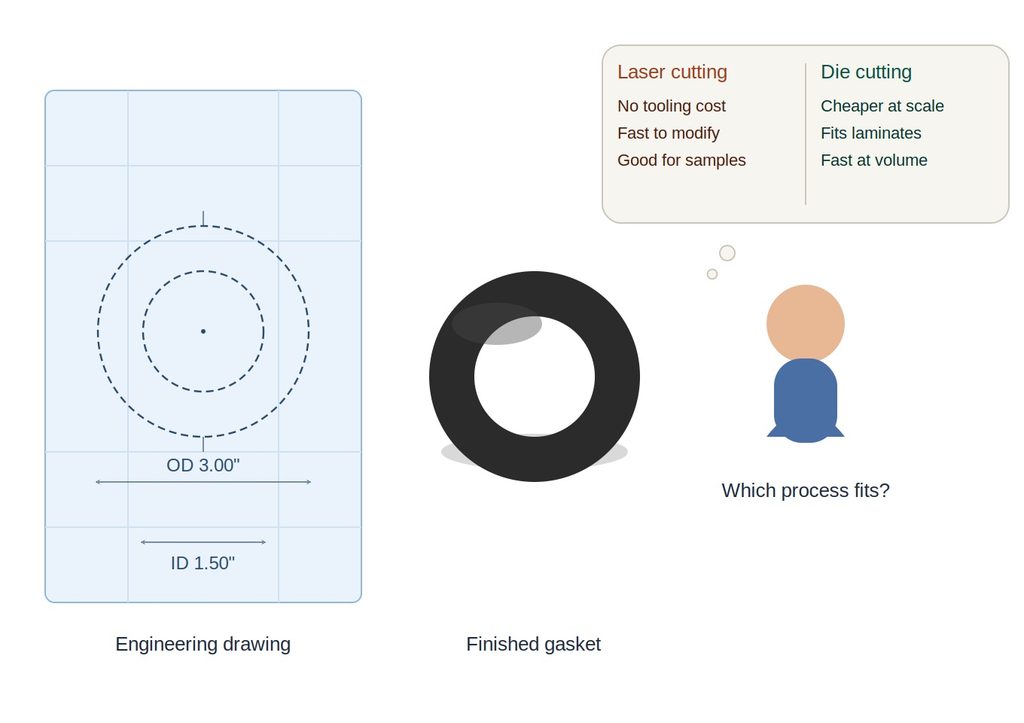
For most parts, the break-even point between laser cutting and die cutting lands somewhere between a few hundred and a couple thousand parts, though the exact number depends on your part’s size, material, and geometry. Below that volume, laser cutting is usually cheaper overall since it carries no tooling cost. Above it, a die pays for itself and starts saving money on every additional part. Here’s how to estimate where that line falls for your project, using how Mag-Knight, which runs both processes in-house, actually walks customers through the decision.
The Break-Even Formula
The math is simpler than it looks:
Break-even quantity = Die cost ÷ (Laser cost per part − Die cost per part)
Die cutting has an upfront tooling cost but a lower cost per part once running. Laser cutting has no tooling cost but a higher cost per part, since every part is cut individually rather than stamped through a fixed die. The break-even quantity is simply the point where the die’s upfront cost has been fully offset by the per-part savings.
A Worked Example
Say a part costs $225 to tool as a die (typical for a moderately complex steel rule die, see our custom die cost breakdown for how that number is built). Laser cutting that same part might run around $0.75 each in cut time, while die cutting it, once tooled, runs closer to $0.10 each in press time. The per-part savings is $0.65.
$225 ÷ $0.65 ≈ 346 parts
Below roughly 346 parts, laser cutting is the cheaper total cost. Above it, the die has paid for itself and every additional part costs less than it would have on the laser.
Quantity
Laser Cutting Total
Die Cutting Total (incl. $225 tooling)
Cheaper Option
50
$37.50
$230.00
Laser
100
$75.00
$235.00
Laser
346
$259.50
$259.60
Break-even
500
$375.00
$275.00
Die
1,000
$750.00
$325.00
Die
5,000
$3,750.00
$725.00
Die
These figures are illustrative, built around typical per-part costs for a mid-complexity part. Your actual break-even point depends on your part’s size, material hardness, and feature count, which affect both the die price and the per-part cutting time on either process. For real numbers, request a quotation and we’ll run this calculation against your actual drawing.
What Shifts the Break-Even Point
A few factors move that 346-part example up or down:
Material hardness. Harder materials cost more to tool (thicker rule) but often see a bigger per-part time savings on die versus laser, which can lower the break-even quantity. See our suitable materials page for what we stock.
Part complexity. More intricate geometries tend to slow laser cutting down more than they slow die cutting down, since a die cuts the whole shape in one stroke regardless of detail. Complex parts often reach break-even sooner than simple ones.
Multi-layer laminates. Parts with bonded layers, like gaskets, are usually die-cut candidates well before the break-even math alone would suggest, since die cutting handles laminates more cleanly than a laser can.
Metal and foil layers. For foil-backed or metal cutting components, tolerance requirements can push the decision in either direction independent of pure cost.
You Don’t Have to Decide Up Front
This is where running both processes under one roof matters. Most projects don’t start by committing to a volume, they start with a design that isn’t locked yet. The practical path is to prototype and validate the part with rapid prototyping laser cutting first, since there’s no tooling cost while the design might still change. Once the design is finalized and your order volume is clear, Mag-Knight can run the break-even math against your real numbers and tell you whether tooling a die makes sense yet, or whether you’re better off staying on laser a while longer.
Because the die, once built, uses the same material spec as the laser-cut prototypes, the transition doesn’t introduce new variables to validate. And since Mag-Knight stores customer-owned dies in-house at no charge, there’s no added cost or delay to having a die ready and waiting once volume crosses the line. See our custom die cutting and custom laser cutting pages for how both sides of that transition work.
Frequently Asked Questions
What’s a typical break-even quantity between laser and die cutting? It varies by part, but a few hundred to a couple thousand parts is typical. Larger, simpler parts and harder materials often break even sooner; small, high-precision parts can take longer.
Can I start with laser cutting and switch to die cutting later? Yes, and this is the most common path. Prototyping or early production on laser cutting lets you validate the design before paying for tooling, then transitioning to a die once volume justifies it.
Does Mag-Knight calculate the break-even point for my specific part? Yes. Send a drawing and expected volume through our quotation page and our engineering team will run the actual numbers rather than relying on a general estimate.
Does material choice affect the break-even point? Yes, significantly. Harder materials cost more to tool but often see a larger per-part time savings from die cutting, which can shift the break-even point lower than it would be for a softer material.
Is there a minimum order size to get a die made? No. You can tool a die for a single order if you choose, but the economics generally favor waiting until your volume approaches the break-even point unless there’s a reason, like tolerance or laminate construction, to prefer die cutting regardless of quantity.
What if my volume is right around the break-even point? That’s exactly when it’s worth getting an actual quote on both. At the margin, small differences in part geometry or material can tip the decision either way, so real numbers beat estimation.
Not sure where your part lands? Request a quote with your drawing and expected volume, and we’ll run the break-even numbers for you. Our engineering library also has more detail on process selection if you want to dig in before reaching out through our contact page.
At Mag-Knight Die Cutting, we hold critical (key) features to ±0.005″, general features to ±0.015″ unspecified to ±0.032″ .
The tolerance you can actually get depends on the material, its thickness, the size of the part, the feature type, and the cutting process. Call out tight tolerances only where the part’s function needs them. That keeps cost down and makes production more repeatable.
If you are an engineer designing a gasket, foam pad, insulator, spacer, or adhesive part, this guide covers what die cutting can realistically hold, why soft materials act differently from metals, and how to dimension your drawing so the quote comes back fast and accurate.
[Image placeholder: Close up of a die cut foam gasket being measured with digital calipers on an inspection table]
Mag-Knight Tolerance Capability
Feature type
Mag-Knight tolerance
Typical examples
Key / critical features
±0.005″
Locating holes, sealing edges, alignment features, hole to hole spacing
Foam, rubber, film, and felt thickness is set by the raw stock
Tip: Mark critical dimensions clearly on the drawing, for example with a key characteristic symbol or a note like “CRITICAL ±0.005″.” All other dimensions can then default to ±0.015″ in your title block.
Tolerance Comparison Chart
Achievable tolerance by feature type (smaller = tighter)

General features      ±0.015"  ███████████████
Key features          ±0.005"  █████
What Affects Die Cutting Tolerances
1. Material Type and Hardness
Soft, compressible materials like open cell foam, sponge, and felt deform under the cutting rule and then recover. That makes them harder to hold tight than firm materials like polyester film, polycarbonate, or rigid rubber. Mag-Knight works with a wide range of substrates. The materials guide can help you match a material to your tolerance needs.
2. Material Thickness
Thicker material usually means wider tolerances. As the rule goes through thick foam or rubber, the material compresses, so the cut edge can come out slightly concave or tapered. For thick parts, tell us whether the dimension applies at the top face, the bottom face, or the midline.
3. Part Size
Larger parts build up more variation across their length. A ±0.005″ callout on a 1″ locating hole spacing is realistic. The same callout on a 30″ perimeter in soft foam may not be.
4. Feature Geometry
Small holes, narrow bridges, and sharp inside corners are harder to cut precisely. Steel rule has physical thickness, so features close together need review. Use internal corner radii at least equal to the material thickness when you can.
Tip: If you’re not sure which process will meet your tolerance, send the drawing. Mag-Knight’s engineering review will recommend the process that holds your critical features at the lowest cost.
6. Adhesives and Laminations
Pressure sensitive adhesive, liners, and laminated layers add thickness variation and can shift during lamination. Put the full layer stack on the drawing and say whether dimensions apply before or after lamination.
How to Specify Tolerances on a Die Cut Drawing
Dimension from functional datums. Use locating holes or mating edges, not arbitrary outside edges.
Use a general tolerance block. For example: “Unless otherwise specified: ±0.015″.”
Flag only the true critical features at ±0.005″. Sealing edges, alignment holes, and clearance features are the usual candidates.
Account for compression. Give the free state dimension and note whether measurement happens compressed or uncompressed.
State the measurement method. Calipers, optical comparator, or vision system can give different readings on soft materials.
Send vector CAD with the PDF. DXF, DWG, or AI along with a dimensioned PDF.
Tip: Tolerancing every feature at ±0.005″ adds inspection time and cost without improving how the part works. Save tight control for the features that matter.
How Mag-Knight Solves Common Tolerance Problems
Engineering problem
How Mag-Knight helps
“My foam gasket doesn’t seal consistently.”
We review material density and compression, and hold the sealing edge to ±0.005″.
“My locating holes don’t line up in assembly.”
We dimension holes from your datums and control hole to hole spacing tightly.
“My current supplier’s parts vary lot to lot.”
Steel rule dies and controlled production give repeatable results across runs.
“I need to verify fit before buying tooling.”
Laser cut prototypes let you test tolerances before committing to a die.
“I don’t know what tolerance to specify.”
Our free engineering review, led by a mechanical engineer, recommends realistic callouts.
Common Tolerance Mistakes to Avoid
Applying ±0.005″ to every dimension on the drawing.
Leaving out a general tolerance block.
Using machined metal tolerances on soft foam or sponge.
Ignoring material thickness variation in stack ups.
Not saying whether dimensions apply before or after lamination.
Dimensioning from outside edges instead of functional datums.
Leaving out the measurement method for compressible materials.
Sending only an image file with no dimensioned drawing.
Benefits of Getting Tolerances Right
Realistic, function based tolerances lower part cost, speed up quoting, cut down on rejected parts, and make production more consistent. With Mag-Knight, key features are held to ±0.005″ and general features to ±0.015″. Add our engineering support and you get parts that fit your assembly the first time.
Mag-Knight holds key features to ±0.005″ and general features to ±0.015″. The final capability depends on material, thickness, part size, and geometry.
What is a standard die cutting tolerance?
A typical general tolerance for die cut parts is around ±0.015″. Tighter tolerances like ±0.005″ are used for critical features such as locating holes and sealing edges.
Can foam be die cut to tight tolerances?
Yes, with some limits. Firm, closed cell foams hold tighter tolerances than soft, open cell foams. Mag-Knight can recommend a foam that meets both your performance and tolerance needs.
Is laser cutting more accurate than die cutting?
Not always. Laser cutting works well for prototypes and intricate shapes with no tooling. Steel rule die cutting is very repeatable in production. The better choice depends on material, volume, and feature requirements.
How does material thickness affect die cut tolerances?
Thicker materials compress more during cutting, which can taper the cut edge and widen tolerances. Thin films and rigid sheets usually hold tighter tolerances.
How should I call out tolerances on a die cut part drawing?
Use a general tolerance block, such as ±0.015″, and flag critical dimensions separately at ±0.005″. Dimension from functional datums and note whether measurements are taken compressed or free state.
Do tighter tolerances cost more?
Yes. Tight tolerances on every feature add inspection time and can require special tooling. Controlling only the critical features keeps cost down.
Can Mag-Knight review my drawing for tolerance feasibility?
Yes. Mag-Knight offers a free engineering review and will recommend realistic tolerances, materials, and processes. Submit your drawing on the quotation page.
Whether you need a gasket, seal, foam pad, insulation component, adhesive-backed part, plastic component, or another custom die-cut shape, providing a few key pieces of information can help a die-cutting company determine the right material, manufacturing process, tooling, quantity, and price.
At Mag-Knight Die Cutting, we work with engineers, purchasing departments, designers, manufacturers, and companies of all sizes. Sometimes a customer sends us a complete CAD drawing. Other times, they have a PDF, a sample part, or simply an idea of what they need.
The more information you can provide, the faster and more accurately we can evaluate your project.
The good news is that you don’t need to have every answer before you contact us.
If you’re unsure about the material, manufacturing process, tolerances, or even how the part should be made, tell us what the part needs to do. That information can be just as valuable as the drawing itself.
What Makes a Good Die-Cutting RFQ?
A good RFQ doesn’t necessarily have to be complicated.
Here’s an example of a useful request:
Part: Custom enclosure gasket Material: EPDM Thickness: 0.062 inch Quantity: 500 initially; approximately 5,000 annually Drawing: DXF and PDF attached Tolerance: ±0.010 inch unless otherwise specified Application: Outdoor electrical enclosure Environment: Outdoor exposure, moisture, temperature variation Adhesive: None Prototype: No — production part Additional information: Please recommend the most economical die-cutting process.
That gives the manufacturer enough information to begin evaluating the job.
The 8 Things You Should Include With a Die-Cutting RFQ
For most projects, the following information will give a die-cutting manufacturer what they need to begin evaluating your job:
Part drawing or CAD file
Material
Material thickness
Part quantity
Required tolerances
Application or intended use
Adhesive or liner requirements
Prototype or production requirements
Let’s look at each one.
1. Provide a Drawing or CAD File
The single most useful thing you can provide with a quote request is a drawing of the part.
A good drawing should show the finished part geometry and identify the dimensions that matter.
Useful drawing information includes:
Overall length and width
Hole sizes
Slot dimensions
Cutouts
Radii
Material thickness
Critical dimensions
Required tolerances
Material specification
Adhesive requirements
Any special notes
If you have a CAD file, send it along with the drawing.
Mag-Knight’s Quotation page currently accepts PDF, DXF, AI, JPG, and DWG drawing formats.
What if I don’t have a CAD drawing?
Don’t let that stop you from requesting a quote.
Depending on the part, you may be able to provide:
A PDF drawing
A physical sample
A sketch
A photograph
An existing part
An older drawing
A DXF or other CAD file
If you only have a physical sample, tell us that when you request the quote.
2. Tell Us What Material You Need
Material selection can have a major effect on both the manufacturing process and the cost of a die-cut part.
Common die-cut materials include:
Rubber
EPDM
Neoprene
Silicone
Buna-N / nitrile
Viton® / FKM
Foam
EVA
Polyurethane
Polycarbonate
Polyester
PVC
PTFE
Cork
Felt
Fiberglass
Fabrics
Adhesive-backed materials
Gasket materials
Plastic films
Magnetic materials
Other flexible or sheet materials
If you know the exact material specification, provide it.
For example:
EPDM, 60 durometer, 0.062-inch thick
is much more useful for quoting than:
Rubber gasket
If you don’t know the material, that’s okay too.
Tell us what the part needs to do.
For example:
“I need a gasket that will be exposed to oil and elevated temperatures.”
Or:
“I need a soft foam pad to provide vibration isolation.”
Or:
“I need a thin plastic insulator.”
Those application requirements can help determine which materials should be considered.
Material thickness is especially important for die-cutting quotes.
Two parts with identical geometry can have very different manufacturing requirements if one is made from 0.020-inch material and the other is made from 0.250-inch material.
Include:
Material: Silicone Thickness: 0.062 inch
If the thickness has a required tolerance, include that as well.
For example:
0.062 ± 0.005 inch
If you’re unsure what thickness is appropriate, tell us what the part does and what the application requires.
Material thickness can affect:
Tooling
Cutting force
Feature size
Part tolerances
Edge quality
Production method
Material handling
Overall cost
4. Tell Us How Many Parts You Need
Quantity is one of the most important pieces of information for a die-cutting quote.
A quote for:
10 pieces
can be very different from a quote for:
10,000 pieces
or:
1,000,000 pieces per year
The quantity helps determine the most appropriate manufacturing process and how tooling costs should be distributed across the production run.
If possible, provide:
Prototype quantity
Initial order quantity
Expected annual quantity
Expected lifetime quantity
You don’t need to know the exact future quantity.
An estimate such as:
“We need 500 initially and expect approximately 5,000 per year.”
is very helpful.
How Quantity Can Affect the Economics of Die Cutting
The chart below illustrates the general relationship between production quantity and the impact of one-time tooling costs.
This is why the expected production quantity is important when comparing die cutting with other manufacturing processes.
A one-time tooling cost becomes a much smaller cost per part as the number of parts increases.
What If I Have a Physical Sample Instead of a Drawing?
A physical sample can still be useful.
If you have an existing part but no CAD drawing, tell us that when requesting a quote.
Depending on the part, a sample can provide information about:
Overall shape
Hole locations
Feature geometry
Material
Thickness
General construction
If possible, provide any information you have about the original material and application.
You can also photograph the sample and include the photographs with your RFQ.
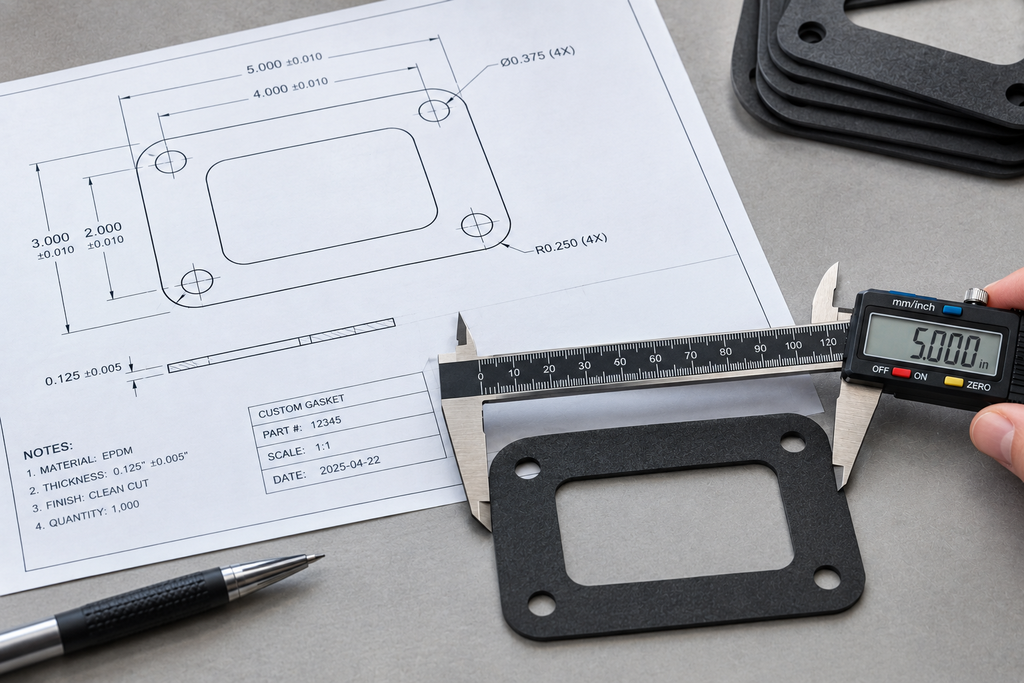
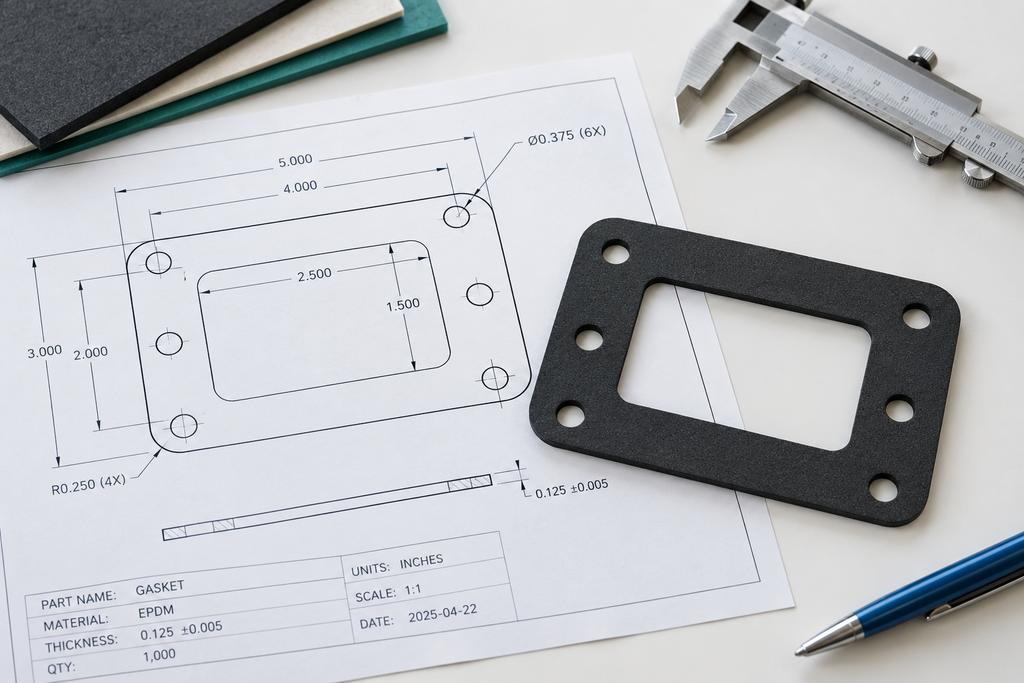
engineering drawing and custom die-cut part for die cutting quote
A Simple Die-Cutting RFQ Checklist
Before submitting your request, check the following:
Part
☐ Part number ☐ Drawing or CAD file ☐ Overall dimensions ☐ Critical features ☐ Hole and slot dimensions ☐ Required tolerances
Material
☐ Material name/specification ☐ Thickness ☐ Hardness/durometer if applicable ☐ Adhesive specification if applicable ☐ Liner specification if applicable
Application
☐ What does the part do? ☐ Temperature range ☐ Chemical exposure ☐ Compression requirements ☐ Environmental exposure ☐ Electrical requirements if applicable
Production
☐ Prototype quantity ☐ Initial order quantity ☐ Expected annual quantity ☐ Production or prototype ☐ Desired delivery date
Special Requirements
☐ Inspection requirements ☐ Packaging requirements ☐ Individual parts or sheets ☐ Kiss cut or through cut ☐ Special certifications or material requirements
You don’t need every box checked before contacting Mag-Knight. If you’re missing information, simply tell us what you know and what you don’t know.
What File Types Can I Send for a Die-Cutting Quote?
Mag-Knight’s Quotation page currently lists these drawing formats:
PDF
DXF
AI
JPG
DWG
A CAD file is especially helpful when the geometry needs to be transferred into tooling.
If you have another format, don’t assume we can’t work with it. Tell us what you have.
How Does the Quote Process Work?
A typical custom die-cutting quote follows a simple process:
1. You send us your part information
Drawing, material, thickness, quantity, application, and any special requirements.
↓
2. We review the part
We evaluate the geometry, material, tolerances, quantity, and manufacturing requirements.
↓
3. We determine the appropriate process
Depending on the job, this could involve die cutting, laser cutting, or another appropriate method.
↓
4. We determine tooling requirements
If a die is required, the tooling cost is included separately from production pricing.
↓
5. We calculate production pricing
Material, press time, quantity, and other job-specific factors are considered.
↓
6. You receive the quotation
The quote provides the information you need to decide how to proceed.
One of the biggest mistakes customers make is waiting until they have a “perfect” RFQ before contacting a manufacturer.
You don’t necessarily need to know:
The exact material
The exact die type
The best cutting process
The exact tooling
Every manufacturing specification
If you have a drawing and know what the part needs to accomplish, that’s a good place to start.
If you have a sample but no drawing, send information about the sample.
If you know the material but aren’t sure about the process, tell us what you’re trying to accomplish.
The purpose of the engineering review is to help determine the most practical way to manufacture the part.
Frequently Asked Questions About Die-Cutting Quotes
What information do I need to get a die-cutting quote?
At minimum, provide the part drawing or sample, material if known, material thickness, quantity, and intended application. Tolerances, adhesive requirements, and special requirements are also helpful.
Do I need a CAD drawing to get a die-cutting quote?
No. A CAD drawing is helpful, but you may also be able to request a quote using a PDF, JPG, physical sample, sketch, or other information. Mag-Knight currently lists PDF, DXF, AI, JPG, and DWG as accepted drawing formats.
What file types does Mag-Knight accept?
The Mag-Knight Quotation page currently lists PDF, DXF, AI, JPG, and DWG drawing formats.
How many parts do I need to order?
There is no single quantity that makes sense for every project. Mag-Knight handles both prototype and production requirements. Providing your expected quantity allows the appropriate manufacturing process and tooling economics to be evaluated.
Does the material affect the die-cutting price?
Yes. Material type, thickness, hardness, availability, and construction can all affect the manufacturing process and cost.
What if I don’t know what material to use?
Tell us what the part needs to do. Temperature, chemicals, compression, flexibility, electrical requirements, and environmental conditions can help determine suitable materials.
What if I don’t know whether my part should be die cut or laser cut?
That’s okay. Material, geometry, quantity, tolerances, and tooling economics all affect the decision. Mag-Knight offers both die cutting and laser cutting and can evaluate the appropriate process for your application.
Can you quote a gasket from a sample?
A physical sample can be useful when a drawing isn’t available. Provide as much information as possible about the material, thickness, application, and quantity.
Should I provide my annual quantity?
Yes, if you know it. Annual usage can be particularly helpful when evaluating tooling and production economics.
Do I need to specify every tolerance?
No. Identify the dimensions that are functionally critical. Applying extremely tight tolerances to every dimension can make a part unnecessarily difficult or expensive to manufacture.
How quickly can I get a quote?
Mag-Knight’s website currently advertises a fast quote process, and the quotation page is the best place to submit the drawing and project information for evaluation.
Ready to Request a Die-Cutting Quote?
The easiest way to get started is to send us what you have.
If you have a complete drawing, include it.
If you have a CAD file, include it.
If you have a physical sample, tell us.
If you’re unsure about the material or manufacturing process, explain what the part needs to do.
We’ll use that information to evaluate the material, tooling, manufacturing process, and production requirements.
Skip the wait and get an instant die price from your PDF or DXF by using our new Instant Online Estimator.
A steel rule die about the size of a piece of paper, with a few simple cut lines or holes, typically runs around $200. Price goes up from there as the part gets bigger, the shape gets more complex, or the material gets harder to cut. Below is what actually drives that number, using how Mag-Knight prices dies day to day.
The Baseline: What a Simple Die Costs
For a paper-sized die with a handful of straight or gently curved cut lines, $200 is a realistic starting point. That price covers the steel rule itself, bending it to your shape, and mounting it into a base ready to run on press. From there, three things move the price: size, feature count, and material hardness. Our custom die cutting page has more on how we scope a new die once we see your drawing.
What Drives the Price Up
Size and feature count are the most intuitive factors: a bigger die needs more steel and more bending, and more cut lines, perforations, or crease lines mean more setup work before the die ever touches a press.
Material hardness is the less obvious one, and it matters more than most people expect. Softer materials like foam and soft rubber cut cleanly with a thin rule, but harder materials such as hard plastics and harder-durometer rubbers need a thicker rule to hold up under repeated impact. Thicker rule costs more outright, and it also cannot bend into fine detail as easily as thin rule can, which limits how intricate a shape can be for a given material.
Material Type
Typical Rule Thickness
Minimum Bend Radius
Fine Detail Capability
Soft foam, soft rubber
Thin rule
1/16″
High, tight curves and fine features are practical
Hard plastics, harder rubbers
Thick rule
3/32″
Lower, sharp inside corners and tiny features get harder to hold
If your part has fine internal detail and needs to be cut from a harder material, that combination is usually where die cost climbs the most, since it can mean designing around a larger minimum bend radius rather than just paying more for steel.
Why Rule Thickness Matters for Your Design
The practical takeaway for engineers: if your material is on the harder end, design features with a bend radius at or above 3/32″ wherever possible. Trying to force a tight radius into thick rule usually means either a redesign later or a die that doesn’t hold up as well in production. If you’re not sure where your material falls, our engineering library has additional reference material on rule selection and design-for-manufacturability, and it’s worth a look before finalizing a drawing.
You Own the Die You Pay For
When Mag-Knight builds your die, you own it. You’re paying for the tooling, so the tooling is yours, the same way it would be if you commissioned any other custom tool. What’s different is that we store it in-house at no extra charge, so it’s ready to run again the moment you place a reorder rather than needing to be rebuilt or shipped back and forth. That’s part of why getting a die scoped correctly the first time matters. It’s not a one-time expense, it’s an asset that sits on our shelf working for you on every future order.
How Long Does a Die Last?
A properly maintained die can produce tens of thousands of impressions before it needs rework, though the exact number depends heavily on the material being cut and how the die is run. Harder materials wear a die faster than soft ones, which is another reason the rule-thickness decision at the start matters for total cost over the life of the tooling, not just the upfront price. Proper storage and handling between runs, which we manage as part of keeping your die in-house, also extends usable life meaningfully compared to a die that gets shipped and reinstalled every order.
Want to Go Deeper on Die Design?
If you want to understand die design beyond pricing, Mag-Knight has a full video series on die design available in the sidebar of our website, covering rule selection, bend radius, and layout considerations in more depth than a single blog post can. It’s a good next step if you’re designing a part in-house before sending us a drawing.
Getting an Accurate Die Quote
Because size, feature count, and material all affect price, the fastest way to get a real number instead of an estimate is to send your drawing and material spec through our quotation page. If you’re still finalizing the design, our rapid prototyping option lets you validate the part with laser cutting first, so you’re not paying for a die until the design is locked. For a broader look at how tooling and production cost combine into a per-part price, see our full cost breakdown.
Frequently Asked Questions
How much does a basic custom die cost? A steel rule die about the size of a piece of paper with a few simple features typically costs around $200. Larger or more complex dies cost more.
Why do harder materials cost more to tool for? Harder materials like hard plastics and higher-durometer rubbers require thicker steel rule to hold up under repeated cutting. Thicker rule costs more and cannot be bent into as fine a detail as thinner rule used for softer materials.
What is the minimum bend radius for a die? For softer materials cut with thin rule, a bend radius around 1/16″ is typical. For harder materials requiring thicker rule, the minimum bend radius is generally 3/32″.
Who owns the die after it’s made? The customer does. Since you pay for the tooling, it belongs to you. Mag-Knight stores it in-house at no extra charge so it’s ready for future reorders.
How many parts can a single die produce? A well-maintained die can typically produce tens of thousands of impressions, though the exact figure depends on the material being cut and how the die is used and stored between runs.
Does die storage cost extra? No. Mag-Knight stores customer-owned dies in-house as part of the service, so reorders don’t require rebuilding or reshipping tooling.
Where can I learn more about die design before I submit a drawing? Our website’s sidebar hosts a full video series on die design covering rule selection, bend radius, and layout. Our engineering library also has written reference material on the same topics.
Ready to find out what your die will cost? Request a quote with your drawing and material, or reach out through our contact page if you’d like to talk through the design first.
The short answer: die cutting wins on cost per part at volume once tooling is paid off, while laser cutting wins on speed to first part and design flexibility since it needs no tooling at all. Which one is actually right for your part depends on your production volume, tolerance requirements, and how locked in your design is. Below is a practical breakdown of both processes. Because Mag-Knight runs both in-house, we can walk through the trade-offs without steering you toward whichever one we happen to offer.
What Is Die Cutting?
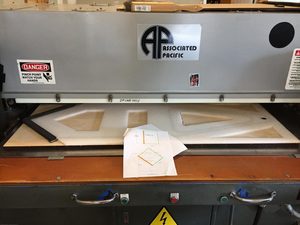
Part ready to be cut in a Die Cutting Press
Die cutting uses a shaped tool, typically a steel rule die or rotary die, pressed through material to cut, crease, or perforate it in a single stroke. Because the die itself is a fixed pattern, die cutting is fast per part once running, but requires a one-time tooling investment before the first part comes off the press. See custom die cutting for the full range of steel rule and rotary work we do.
Typical tolerance: ±0.005″ on key features and ±0.015″ on general features at Mag-Knight, depending on material and geometry
Typical tooling cost: $200–$250 for a standard steel rule die with moderate features (see our full cost breakdown for how that number is built)
Best fit: Medium-to-high volume runs, multi-layer laminates, gaskets, repeatable production parts
What Is Laser Cutting?
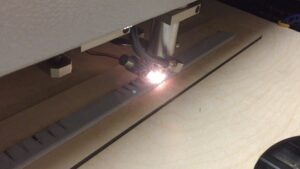
Silicone Bulb Seal Being Laser Cut
Laser cutting uses a focused beam to cut material directly from a digital file, with no physical tool required. That makes it the default choice for prototypes, design iterations, and any part where the design might still change. Our custom laser cutting service runs the same materials as our die-cutting line, so switching between the two processes doesn’t mean switching vendors.
Typical tolerance: ±0.002″ to ±0.005″, generally tighter than mechanical die cutting on thin materials
Typical tooling cost: $0. Cost is driven entirely by cut time per part
Best fit: Prototypes, short runs, intricate or frequently-changing geometries, one-off or low-volume parts
Die Cutting vs. Laser Cutting at a Glance
Factor
Die Cutting
Laser Cutting
Tooling cost
$200–$250 typical
$0
Cost driver
Press time (~$100/hr)
Cut time per part
Tolerance
±0.005″ key / ±0.015″ general
±0.002″–0.005″
Speed at volume
Very fast once tooled
Slower per part
Design changes
Requires new/modified die
Instant, just update the file
Best volume range
Medium to high
Prototype to low volume
Multi-layer laminates
Excellent
Limited (heat can affect adhesives)
When Die Cutting Wins
Die cutting is the better economic choice once your part design is locked and your volume is high enough to amortize the tooling cost. A $225 die spread across 5,000 parts adds pennies to each one, and rotary die cutting in particular can move through high volumes far faster than a laser can trace the same shape one part at a time. Die cutting is also the stronger choice for multi-layer laminates, such as foam-to-adhesive or fabric-to-foam, where a single die stroke cuts cleanly through bonded layers that a laser’s heat could distort or delaminate. If your part is a gasket or uses layered materials, this is usually where you land.
When Laser Cutting Wins
Laser cutting wins whenever the design isn’t final, the volume doesn’t justify tooling, or the geometry is intricate enough that die maintenance would be a headache. Because there’s no tooling to build, laser-cut parts can often ship faster on a first order than a tooled die-cut part, even though per-part cost is higher. It’s also the better fit for tight-tolerance features on thin films and foils, and for rapid prototyping runs where you need real parts in hand before committing to a hard die.
Cost Comparison: Where the Break-Even Point Is
Because die cutting carries an upfront tooling cost and laser cutting doesn’t, there’s a volume point where die cutting becomes cheaper overall. Roughly speaking: divide the die’s tooling cost by the per-part cost difference between the two processes to estimate your break-even quantity. For a typical $225 die and a modest per-part savings on press time, that break-even point often falls somewhere between a few hundred and a couple thousand parts, depending on part size and material. Below that volume, laser cutting is usually the cheaper total cost; above it, die cutting wins. See pricing for how we scope both.
Why It Doesn’t Have to Be an Either/Or
Because Mag-Knight runs both processes under one roof, the practical path for most projects is to prototype with laser cutting while the design is still moving, then transition to a die once the part is locked and volume justifies it, using the same material spec throughout so nothing changes except the process. Our engineering team reviews incoming drawings and recommends which process fits at each stage, rather than defaulting to whichever machine happens to be free. That review is included at no charge when you request a quotation.
If you’re weighing metal cutting options as part of this decision, the same logic applies. Thin foils and shim stock can go either way depending on tolerance and volume, so it’s worth getting a recommendation before committing to tooling either direction.
Frequently Asked Questions
Is laser cutting more accurate than die cutting? Not always. Laser cutting can hold ±0.002″–0.005″ on thin materials and fine detail, while Mag-Knight holds die-cut key features to ±0.005″ and general features to ±0.015″. Steel rule die cutting is also very repeatable at production volume, so the better choice depends on material, volume, and feature requirements.
Which is cheaper, laser cutting or die cutting? It depends on volume. Laser cutting has no tooling cost, so it’s usually cheaper for prototypes and short runs. Die cutting has an upfront tooling cost (typically $200–$250) but a lower cost per part at volume once that tooling is paid off.
Can the same part be laser cut first and die cut later? Yes, and this is a common path. Laser cutting is often used to prototype and validate a design before investing in a die, using the same material so the transition to production doesn’t introduce new variables.
Does laser cutting work on multi-layer or adhesive-backed materials? It can, but with more limitations than die cutting. Heat from the laser can affect adhesives or cause delamination on bonded layers, which is why die cutting is generally preferred for laminates and gasket constructions.
How do I know which process is right for my part? The fastest way is to send your drawing and expected volume through our quotation page. Since Mag-Knight runs both processes, our engineering team can recommend whichever fits your tolerance, material, and volume, without a bias toward one machine over the other.
What if my volume is somewhere in the middle? That’s exactly when it’s worth requesting numbers on both. If you’re between a few hundred and a couple thousand parts, the better process can genuinely go either way depending on part geometry and material, so getting an actual quote on both beats guessing.
Not sure which process fits your part? Request a quote or reach out through our contact page. We’ll recommend laser or die cutting based on your drawing, not on which machine we’d rather run. Our engineering library also has more reference material on tolerances and design-for-manufacturability if you want to dig in further.
Engineers evaluating die cutting cost for a new part almost always ask the same two questions: what does the tooling cost, and what does each part cost once it’s running. Both answers depend less on the material and more on two numbers — the price of the die itself, and the shop’s hourly production rate. Here’s how those numbers actually work, using real figures from how Mag-Knight prices jobs.
Tooling Cost: What a Die Actually Costs
For a steel rule die sized to a standard sheet (“paper size”) with a moderate number of features — cut lines, perforations, creases — tooling typically runs $200–$250. That’s a one-time cost tied to the die, not to the part count, which is why die-cut tooling is so much cheaper to justify than injection-mold tooling for short and medium production runs.
A few things that move that number:
Feature count. More cut lines, tighter internal features, or multiple die stations (cutting + creasing + perforating in one pass) add to the base price.
Die size. A die scaled to a full sheet costs more than one for a small part, though not proportionally — most of the cost is in machining the rule pattern, not the steel blank.
Material-specific tooling. Rotary dies for high-volume web-fed production cost more upfront than steel rule dies but pay that back in cycle time at volume.
See custom die cutting for how we scope tooling on a new job, or if you’re still validating a design, rapid prototyping skips the die entirely by laser-cutting your first parts.
Production Cost: The $100/Hour Number
Once the die exists, part cost comes down to press time. Mag-Knight targets $100 per hour of production time — a number we hold to deliberately, because it’s the lever that turns a $200 die into pennies-per-part pricing once you’re running any real volume. A press that’s cutting continuously at $100/hr can produce hundreds of parts in that hour depending on part size and material, which is where the per-part price actually comes from: hourly rate divided by parts-per-hour, not some fixed “die cutting is expensive” assumption.
This matters because engineers often compare die cutting to laser or waterjet cutting on a per-part basis without accounting for the fact that die cutting’s hourly rate is doing the same job other trades charge far more for.
How $100/Hour Compares to Other Skilled Trades
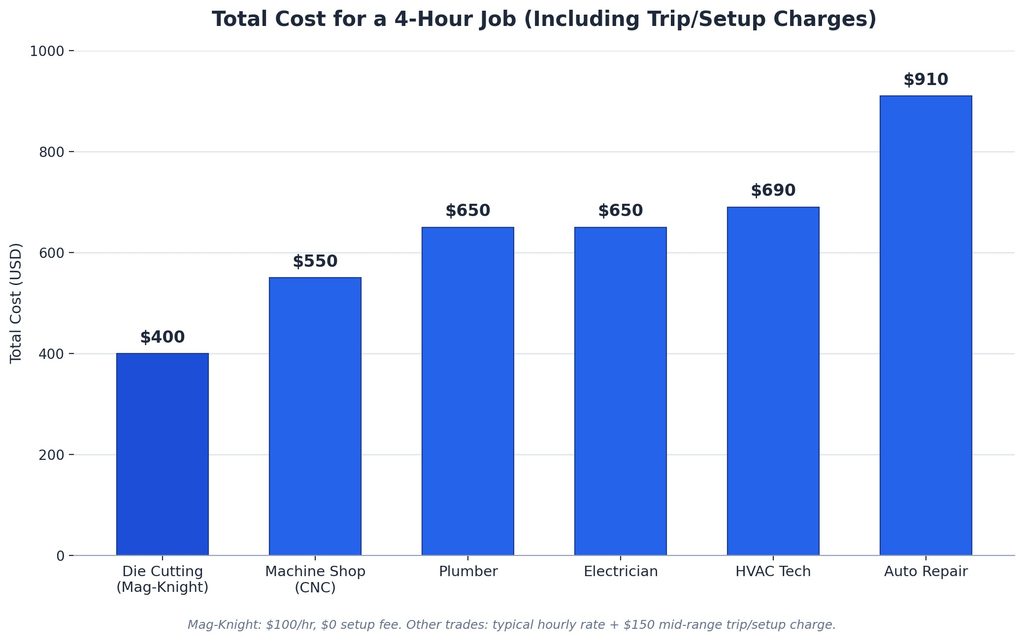
$100/hr looks reasonable enough on its own, but it stands out once you set it next to what other skilled trades charge for comparable expertise and equipment investment. Auto repair, for example, commonly runs around $190/hr at the higher end of the market in 2026. Electricians, plumbers, and HVAC technicians typically fall in a $100–$150/hr band depending on region and specialty, and a general machine shop doing CNC work is often in a similar range, closer to $75–$125/hr. Mag-Knight’s $100/hr sits at or below all of them, without the setup-fee-free pricing model or in-house engineering review included at no extra charge.
(Rates shown are general industry ranges for comparison purposes and vary by region and shop.)
Hourly rate alone doesn’t tell the full story, though. Most service trades also charge a trip or setup charge — typically $50–$250 — just to show up and begin work, on top of the hourly rate. Mag-Knight doesn’t charge this. There’s no setup fee, no trip charge, no minimum order fee — the $100/hr production rate is the whole cost of press time.
That difference compounds on any real job. Here’s what a 4-hour job actually costs once the trip/setup charge (using a $150 mid-range figure) is factored in:
Even against a machine shop billing the same $100/hr rate, Mag-Knight comes out lower on total job cost simply because there’s no setup fee added on top. The gap widens further against trades that both charge more per hour and add a trip charge on every visit.
The takeaway isn’t that die cutting is unusually cheap in isolation — it’s that $100/hr buys you a process capable of producing hundreds of finished parts per hour, not one repair or one service call. That’s what actually drives the per-part cost down at volume.
Estimating Your Total Part Cost
A rough formula for budgeting a new part:
Total cost ≈ Die cost + (Press hours × $100) ÷ Quantity
For example: a $225 die, 2 hours of press time producing 2,000 parts, works out to roughly $0.21 per part in tooling and production combined — before material. Material cost is added separately and varies by type; see suitable materials for what we stock and typical pricing tiers.
For parts involving metal layers or laminates, metal cutting and gaskets have their own typical cost ranges since tolerance and layer count affect both tooling and press time.
Getting an Accurate Quote
The fastest way to get real numbers instead of estimates is to request a quotation with your drawing and expected volume — tooling and per-part pricing both depend on specifics we can’t fully estimate from a material name alone. Our engineering library also has reference material on tolerances and design-for-manufacturability if you’re still finalizing the part.
Frequently Asked Questions
How much does a die cost for a small part? For a standard paper-sized steel rule die with moderate features, expect roughly $200–$250. Simpler dies with fewer features can run lower; dies with many stations (cut, crease, perforate) or tight tolerances can run higher.
Is die cutting cheaper than laser cutting at volume? Generally yes, once tooling is paid off. Laser cutting has no tooling cost but is slower per part, so it favors prototypes and short runs; die cutting favors medium-to-high volume where the die cost amortizes across many parts.
Why is Mag-Knight’s $100/hr rate relevant to my quote? It’s the production-time component of your per-part price. Because we don’t charge setup fees on top of it, the $100/hr rate is close to the full cost driver for your quote once tooling is accounted for separately.
Does a higher part complexity always mean higher cost? Not necessarily. Complexity affects tooling cost and press time, but a simple high-volume part can cost more in total than a complex low-volume part if the volume is high enough — it’s worth running both scenarios through the formula above.
How do I get an exact quote instead of an estimate? Send your drawing and expected quantity through our quotation page. Our engineering team reviews it and returns tooling and per-part pricing specific to your design.
Have a part in mind? Request a quote or reach out through our contact page and we’ll walk you through tooling and production cost before you commit.
Most people researching die-cut materials don’t start with “what is die-cut foam” — they start with a part they need to build: a gasket, a shielding component, a packaging insert. The fastest way to land on the right material is to work backward from what the part has to do, not forward from a materials list.
This guide walks through the most common part applications we quote at Mag-Knight, the material families that typically fit each one, and what drives cost and lead time — so you can walk into a quote request already knowing what to ask for.
Sealing and Gaskets
If your part needs to keep out moisture, dust, or air, you’re in gasket territory. Material choice here comes down to compression set, temperature range, and chemical exposure.
Typical materials: Closed-cell foam, EPDM or neoprene rubber, silicone sponge
What drives the choice: Operating temperature and how much compression the joint will see over its life
Cost note: Rubber sheet stock runs a wider price range than foam depending on durometer and cure type — worth specifying early to avoid re-quoting
Where we cut these: See our custom die cutting capabilities, or go straight to our dedicated gaskets page for examples and specs
Packaging and Protective Inserts
Inserts that cushion or protect a shipped product don’t usually need tight tolerances — they need consistent thickness and cost efficiency at volume.
What drives the choice: Impact protection needed vs. shipping weight and material cost at volume
Cost note: Because we don’t charge setup fees regardless of order size, small packaging-insert runs are often far cheaper to prototype with us than with shops that charge $75–$100 just to start tooling
Where we cut these: Our suitable materials page has the full list of foam and board stock we keep in-house
Electrical, EMI Shielding, and Thermal Management
These parts often combine a soft material with a conductive or metal layer, which narrows the material list quickly.
What drives the choice: Shielding effectiveness required and whether the part needs to flex during assembly
Cost note: Metal-laminate parts typically need tighter tolerance control, which is where our stated ±.005″ tolerance and in-house engineering review matter most
Where we cut these:Metal cutting covers foil and thin-gauge sheet work specifically
Medical, Transportation, and Industrial Components
Parts headed into medical devices, vehicles, or industrial equipment usually carry certification, cleanliness, or documentation requirements on top of the material spec itself.
What drives the choice: Regulatory or OEM spec requirements, plus repeatability across production lots
Cost note: These runs benefit most from an upfront engineering review, since a material substitution caught before tooling is far cheaper than one caught after a failed inspection
Where we cut these: Ask about SPC quality tracking when you request your quotation
Prototypes and Short Runs
If you’re still validating a design, material choice should optimize for speed and low cost per iteration, not final production economics.
Typical materials: Whatever matches your intended production material most closely — foam, rubber, or plastic sheet stock, cut via laser rather than a hard die
What drives the choice: Turnaround time and avoiding tooling cost before the design is locked
Cost note: Laser cutting skips hard-tool costs entirely, which is why it’s the default for prototypes
Where we cut these: See rapid prototyping for turnaround and pricing specific to short runs
Material Selection by Application
Application
Typical Material
Key Selection Driver
Best Process
Sealing / gaskets
Foam, EPDM, silicone
Temperature & compression set
Steel rule / rotary
Packaging inserts
PE foam, chipboard, corrugated
Cost at volume
Steel rule
EMI shielding
Conductive foam, foil laminate
Shielding effectiveness
Metal cutting / steel rule
Medical / transportation
Medical-grade foam, engineered plastic
Regulatory spec, repeatability
Steel rule / rotary
Prototypes
Matches production material
Speed, no tooling cost
Laser cutting
How to Get an Accurate Quote Faster
The single biggest time-saver when requesting a quote is telling us the application, not just the material — “gasket for outdoor electrical enclosure” gets you a faster, more accurate material recommendation than “need foam cut.” Our engineering library has additional design and tolerance reference material if you want to dig into the specs yourself before requesting pricing.
Frequently Asked Questions
I don’t know what material I need — can you recommend one? Yes. Our company president, a mechanical engineer, personally reviews incoming drawings and application requirements and recommends a material and process before quoting.
Does material choice affect lead time? Yes — materials we stock in-house typically ship faster than specialty or certified materials that require sourcing. Ask about stocked materials when requesting your quote.
Is there a minimum order for prototype runs? No setup fees. Minimum order is 5 pieces. Because we don’t charge setup fees, small prototype runs are priced the same way as production runs, just at lower total volume.
Can the same material be used for a prototype and the final production run? Usually, yes — we typically prototype with laser cutting for speed and switch to a hard die for production once the design is locked, using the same material spec throughout.
What if my application needs a metal-backed or laminated material? That’s common in shielding and thermal-management parts. Let us know the layer stack-up (material + adhesive + backing) when requesting a quote so tolerances can be set correctly across all layers.
Know your application but not sure which material fits? Request a quote and our engineering team will recommend the material and process before you commit to tooling.If you are looking for a local company in the desert SW, see our sister company Southwest-Diecutting.com
When engineers, designers, and purchasing teams need a custom gasket, seal, pad, insulator, or other precision component, one of the first questions is:
What materials can be die cut?
The answer is: a wide variety of materials can be die cut, including rubber, silicone, foam, plastics, films, fabrics, felt, cork, paper, composites, gasket materials, adhesive-backed materials, and many other sheet or flexible materials.
However, not every material is best suited to the same cutting process. Material type, thickness, hardness, part geometry, tolerance requirements, production quantity, and the intended application all play a role in determining the best manufacturing method.
At Mag-Knight Die Cutting, we work with a wide range of materials and can help determine whether die cutting, laser cutting, or another process is appropriate for your part.
Common Materials That Can Be Die Cut
Here are some of the most common material categories used for custom die-cut parts.
Rubber
Rubber is one of the most common materials used for die-cut components. It can be converted into custom gaskets, seals, washers, pads, vibration isolators, and other industrial parts.
Common die-cut rubber materials include:
EPDM
Neoprene
Buna-N / Nitrile
Silicone
SBR
Butyl rubber
Viton® / FKM
Natural rubber
Hypalon®
Other specialty rubber compounds
The best rubber depends on the environment in which the finished part will be used. Temperature, chemicals, oil, water, ozone, compression, and other operating conditions may all affect material selection.
Gasket applications often require materials selected for specific environmental conditions.
Depending on the application, die-cut gasket materials may need to resist:
Oil
Water
Chemicals
Heat
Ozone
Weathering
Compression
Vibration
Pressure
Common gasket materials include EPDM, neoprene, silicone, Buna-N/Nitrile, Viton®/FKM, Hypalon®, compressed non-asbestos materials, and other specialty gasket materials.
Choosing the right gasket material is about more than simply finding something that can be cut. The material must also perform properly in the finished application.
Fabrics and Textiles
Many fabrics and textile materials can be die cut into precise, repeatable shapes.
Examples include:
Felt
Cotton
Canvas
Polyester
Flannel
Wool
Muslin
Burlap
Vinyl
Leather
Hook-and-loop materials
Die-cut fabrics may be used for insulation, filtration, seals, protective components, pads, spacers, and other industrial applications.
The construction and thickness of the fabric can affect the cutting process and achievable tolerances.
Felt
Felt is commonly used for seals, washers, filters, insulation, anti-scratch pads, vibration control, and spacers.
Depending on its composition and density, felt can be die cut into simple or relatively intricate shapes.
Cork
Cork can be die cut into gaskets, washers, seals, pads, spacers, and insulating components.
Cork’s compressibility and other physical properties make it useful in certain sealing and industrial applications.
Paper, Cardboard and Other Sheet Materials
Die cutting is widely used with paper-based and fiber-based materials.
Examples include:
Paper
Paperboard
Chipboard
Cellulose
Corrugated cardboard
Corrugated plastic
Other fiber-based sheet materials
These materials can be used for gaskets, spacers, insulation, templates, packaging components, and other applications.
Composites and Fiberglass
Some composite materials can be die cut, while others may require laser cutting or another manufacturing process.
Examples include:
Fiberglass
Carbon fiber
Carbon fiber prepreg
Aramid
Kevlar®
Composite sheet materials
Material construction and thickness are particularly important when determining the appropriate cutting process.
Magnetic Materials
Flexible magnetic sheet can be die cut into custom shapes for applications such as:
Magnetic seals
Labels
Displays
Flexible components
Gaskets
Custom promotional products
Adhesive-Backed Materials
Adhesive-backed materials are particularly useful when a finished component needs to be both cut to shape and applied to another surface.
Examples include:
Pressure-sensitive adhesive
Double-sided adhesive
Adhesive-backed foam
Adhesive-backed rubber
Adhesive-backed plastic film
Transfer adhesive
These materials can be converted into gaskets, mounting pads, insulation, seals, spacers, labels, and protective films.
Can Any Material Be Die Cut?
No.
This is an important distinction.
A material may be cuttable without being a good candidate for conventional die cutting.
Material hardness, thickness, flexibility, part geometry, production quantity, and required tolerance all affect process selection.
For example, a thin flexible plastic film may be an excellent candidate for steel-rule die cutting, while a thick or rigid plastic may be better suited to laser cutting.
That’s why we evaluate the material and the part together, rather than simply asking whether a particular material can be cut.
If you have a material you’re unsure about, our Materials Guide provides additional information.
How Does Material Thickness Affect Die Cutting?
Thickness is one of the most important considerations when evaluating a material.
A material that cuts easily at one thickness may behave very differently at another.
Thickness can affect:
Cutting force
Tool selection
Part tolerances
Edge quality
Small features
Minimum hole size
Material handling
Production speed
The material’s hardness and flexibility are also important. Two materials with the same thickness can behave very differently during the cutting process.
Does Material Hardness Matter?
Yes.
Soft, flexible materials such as rubber and foam behave differently from harder plastics, composites, and other sheet materials.
Hardness can affect the cutting force required, edge quality, tooling, part geometry, and the best manufacturing process.
For this reason, providing the exact material specification and thickness when requesting a quote is helpful.
What About Small Holes and Complex Shapes?
Part geometry matters just as much as the material.
Small holes, narrow sections, tight spacing, sharp corners, and intricate shapes can affect tooling and production requirements.
A part may be easy to cut in one material but difficult to manufacture in another.
If you have a drawing, CAD file, or sample part, we can evaluate the geometry along with the material requirements.
Die Cutting vs. Laser Cutting
One of the most common questions we receive is whether a part should be die cut or laser cut.
Neither process is automatically better for every application.
Die cutting is often a good choice when:
You are producing repeat quantities
The material is flexible or compressible
The part geometry is established
You need consistent production
You are producing gaskets, seals, pads, or similar components
Production volume justifies tooling
Laser cutting can be useful when:
You are producing prototypes
Quantities are relatively low
The design changes frequently
The material or geometry is difficult to die cut
You want to avoid dedicated tooling for an initial run
Mag-Knight provides both Custom Die Cutting and Laser Cutting, allowing the process to be selected based on the actual requirements of the part.
How Do I Choose the Right Material?
The best material isn’t necessarily the easiest material to cut.
Start with the requirements of the finished component.
Ask:
What temperature will the part see?
Will it contact oil, fuel, water, or chemicals?
Does it need to seal?
Does it need to compress?
Does it need to be flexible?
Does it need to provide electrical insulation?
Does it need to resist abrasion?
Does it need to withstand outdoor exposure?
What thickness is required?
What quantity will be produced?
Once those requirements are known, the material and manufacturing process can be evaluated together.
If you’re not sure which material to specify, tell us what the part needs to do. That information can be just as useful as knowing the material name.
What Information Do I Need for a Die-Cutting Quote?
The more information you provide, the easier it is to determine the appropriate material, process, tooling, and pricing.
For a quote, it’s helpful to provide:
Material type
Material thickness
Part dimensions
Quantity
Required tolerances
Application
Drawing or CAD file
Adhesive requirements
Temperature requirements
Chemical exposure
Special surface requirements
Prototype or production requirements
Mag-Knight’s Quotation page explains how to submit your drawing. PDF, DXF, AI, JPG, and DWG formats are currently listed as acceptable drawing formats.
If you have an existing part but don’t have a drawing, a sample may also be useful.
What File Types Can I Send?
If you have a drawing, CAD file, or other representation of the part, send it with your RFQ.
Our Quotation page currently lists PDF, DXF, AI, JPG, and DWG among the accepted drawing formats.
If you don’t have a CAD drawing, let us know what you have and we can discuss the best way to proceed.
What If I Don’t Know Which Material to Use?
That’s not unusual.
If you know the application requirements but aren’t sure which material is appropriate, provide as much information as possible about how the part will be used.
For example:
“I need a gasket that will seal oil at elevated temperature.”
Or:
“I need a compressible pad to isolate vibration.”
Or:
“I need a thin plastic insulator with adhesive on one side.”
Those requirements can help determine which materials and manufacturing processes should be considered.
Explore Die-Cutting Materials
Mag-Knight works with a broad range of materials for custom die-cutting applications.
The Materials Guide includes materials such as ABS, acrylic, aluminum, aramid, rubber, EPDM, felt, fiberglass, foam, HDPE, neoprene, polycarbonate, polypropylene, polyurethane, PVC, silicone sheeting, stainless steel, Teflon®, UHMW, Viton®, wood, and many others.
The site also notes that material thickness, hardness, complexity, and other characteristics can affect whether die cutting, laser cutting, or plasma cutting is the most appropriate process.
If you’re not sure whether your particular material can be processed, don’t guess. Send us the material specification, drawing, sample, or application requirements and we’ll help determine the appropriate manufacturing approach.
Frequently Asked Questions
What materials can be die cut?
Many sheet and flexible materials can be die cut, including rubber, silicone, EPDM, neoprene, foam, plastics, films, fabrics, felt, cork, paper, composites, gasket materials, and adhesive-backed materials. The suitability of a specific material depends on its thickness, hardness, geometry, and application.
Can rubber be die cut?
Yes. Rubber is one of the most common materials used for custom die-cut parts, including gaskets, seals, washers, pads, and vibration-control components.
Can silicone be die cut?
Yes. Silicone sheet can be die cut into gaskets, seals, washers, pads, and other custom components.
Can foam be die cut?
Yes. Many types of foam can be die cut, including EVA, polyurethane, closed-cell foam, sponge rubber, and foam gasket materials.
Can plastic be die cut?
Yes. Many plastics and plastic films can be die cut. The type and thickness of the plastic are important factors when selecting the manufacturing process.
Can EPDM be die cut?
Yes. EPDM is commonly used for die-cut gaskets and seals. The specific material specification and part requirements should be evaluated before production.
Can neoprene be die cut?
Yes. Neoprene can be die cut into gaskets, seals, pads, insulation, and other custom components.
Can Viton® be die cut?
Yes. Viton®/FKM sheet can be die cut for seals and gaskets where chemical and temperature resistance are important considerations.
Can adhesive-backed materials be die cut?
Yes. Adhesive-backed foam, rubber, plastic films, transfer adhesives, and other pressure-sensitive materials can often be converted into custom shapes.
Can thin metal be die cut?
Some thin metals and shim materials can be processed using appropriate cutting methods. Depending on the material, thickness, and geometry, laser or plasma cutting may be a better option.
Is every material suitable for steel-rule die cutting?
No. Material thickness, hardness, flexibility, geometry, and production requirements all affect whether steel-rule die cutting is appropriate.
How thick can a material be for die cutting?
There isn’t one maximum thickness that applies to every material. The practical limit depends on the material, hardness, density, geometry, tooling, and equipment.
How do I know which material is right for my part?
Start with the application requirements, including temperature, chemicals, compression, flexibility, electrical requirements, abrasion, and environmental exposure. These requirements can then be used to identify appropriate materials.
Can you make a die-cut part from a sample?
An existing sample can provide useful information for developing a replacement or custom part. Contact us to discuss your sample and requirements.
Need Help Choosing a Die-Cutting Material?
If you’re trying to determine what material to use, whether your material can be die cut, or whether die cutting or laser cutting is the better process, we’d be happy to take a look.
Send us your drawing, material specification, sample, or simply describe what the part needs to do.