


Engineers evaluating die cutting cost for a new part almost always ask the same two questions: what does the tooling cost, and what does each part cost once it’s running. Both answers depend less on the material and more on two numbers — the price of the die itself, and the shop’s hourly production rate. Here’s how those numbers actually work, using real figures from how Mag-Knight prices jobs.
Tooling Cost: What a Die Actually Costs
For a steel rule die sized to a standard sheet (“paper size”) with a moderate number of features — cut lines, perforations, creases — tooling typically runs $200–$250. That’s a one-time cost tied to the die, not to the part count, which is why die-cut tooling is so much cheaper to justify than injection-mold tooling for short and medium production runs.
A few things that move that number:
- Feature count. More cut lines, tighter internal features, or multiple die stations (cutting + creasing + perforating in one pass) add to the base price.
- Die size. A die scaled to a full sheet costs more than one for a small part, though not proportionally — most of the cost is in machining the rule pattern, not the steel blank.
- Material-specific tooling. Rotary dies for high-volume web-fed production cost more upfront than steel rule dies but pay that back in cycle time at volume.
See custom die cutting for how we scope tooling on a new job, or if you’re still validating a design, rapid prototyping skips the die entirely by laser-cutting your first parts.
Production Cost: The $100/Hour Number
Once the die exists, part cost comes down to press time. Mag-Knight targets $100 per hour of production time — a number we hold to deliberately, because it’s the lever that turns a $200 die into pennies-per-part pricing once you’re running any real volume. A press that’s cutting continuously at $100/hr can produce hundreds of parts in that hour depending on part size and material, which is where the per-part price actually comes from: hourly rate divided by parts-per-hour, not some fixed “die cutting is expensive” assumption.
This matters because engineers often compare die cutting to laser or waterjet cutting on a per-part basis without accounting for the fact that die cutting’s hourly rate is doing the same job other trades charge far more for.
How $100/Hour Compares to Other Skilled Trades
$100/hr looks reasonable enough on its own, but it stands out once you set it next to what other skilled trades charge for comparable expertise and equipment investment. Auto repair, for example, commonly runs around $190/hr at the higher end of the market in 2026. Electricians, plumbers, and HVAC technicians typically fall in a $100–$150/hr band depending on region and specialty, and a general machine shop doing CNC work is often in a similar range, closer to $75–$125/hr. Mag-Knight’s $100/hr sits at or below all of them, without the setup-fee-free pricing model or in-house engineering review included at no extra charge.
| Trade | Typical Hourly Rate |
|---|---|
| Die Cutting (Mag-Knight) | $100 |
| Auto Repair | ~$190 |
| Electrician | ~$125 |
| Plumber | ~$125 |
| HVAC Technician | ~$135 |
| Machine Shop (CNC) | ~$100 |
(Rates shown are general industry ranges for comparison purposes and vary by region and shop.)
Hourly rate alone doesn’t tell the full story, though. Most service trades also charge a trip or setup charge — typically $50–$250 — just to show up and begin work, on top of the hourly rate. Mag-Knight doesn’t charge this. There’s no setup fee, no trip charge, no minimum order fee — the $100/hr production rate is the whole cost of press time.
That difference compounds on any real job. Here’s what a 4-hour job actually costs once the trip/setup charge (using a $150 mid-range figure) is factored in:
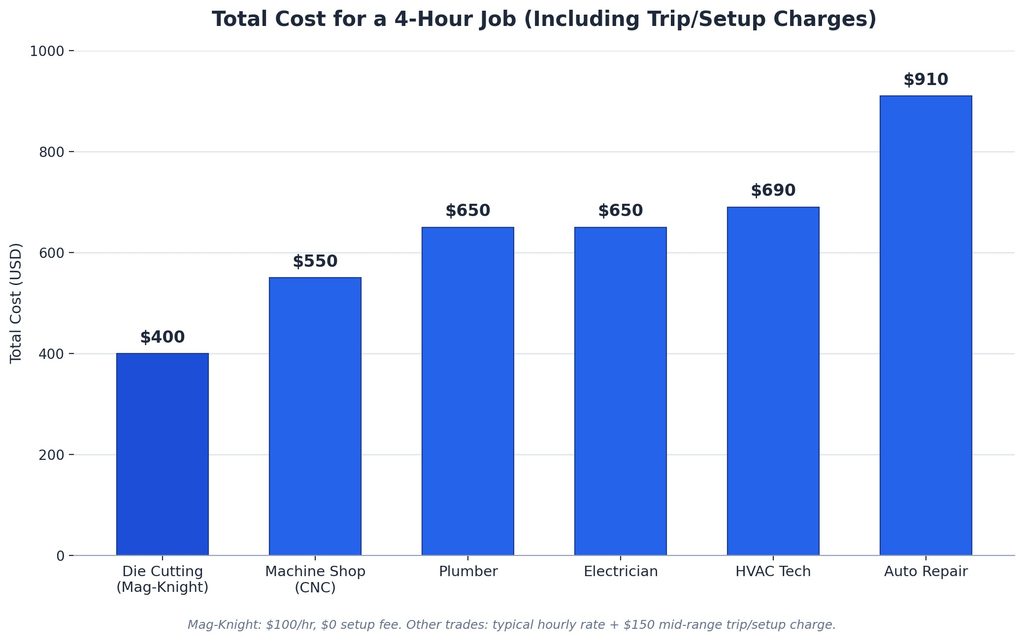
Even against a machine shop billing the same $100/hr rate, Mag-Knight comes out lower on total job cost simply because there’s no setup fee added on top. The gap widens further against trades that both charge more per hour and add a trip charge on every visit.
The takeaway isn’t that die cutting is unusually cheap in isolation — it’s that $100/hr buys you a process capable of producing hundreds of finished parts per hour, not one repair or one service call. That’s what actually drives the per-part cost down at volume.
Estimating Your Total Part Cost
A rough formula for budgeting a new part:
Total cost ≈ Die cost + (Press hours × $100) ÷ Quantity
For example: a $225 die, 2 hours of press time producing 2,000 parts, works out to roughly $0.21 per part in tooling and production combined — before material. Material cost is added separately and varies by type; see suitable materials for what we stock and typical pricing tiers.
For parts involving metal layers or laminates, metal cutting and gaskets have their own typical cost ranges since tolerance and layer count affect both tooling and press time.
Getting an Accurate Quote
The fastest way to get real numbers instead of estimates is to request a quotation with your drawing and expected volume — tooling and per-part pricing both depend on specifics we can’t fully estimate from a material name alone. Our engineering library also has reference material on tolerances and design-for-manufacturability if you’re still finalizing the part.
Frequently Asked Questions
How much does a die cost for a small part? For a standard paper-sized steel rule die with moderate features, expect roughly $200–$250. Simpler dies with fewer features can run lower; dies with many stations (cut, crease, perforate) or tight tolerances can run higher.
Is die cutting cheaper than laser cutting at volume? Generally yes, once tooling is paid off. Laser cutting has no tooling cost but is slower per part, so it favors prototypes and short runs; die cutting favors medium-to-high volume where the die cost amortizes across many parts.
Why is Mag-Knight’s $100/hr rate relevant to my quote? It’s the production-time component of your per-part price. Because we don’t charge setup fees on top of it, the $100/hr rate is close to the full cost driver for your quote once tooling is accounted for separately.
Does a higher part complexity always mean higher cost? Not necessarily. Complexity affects tooling cost and press time, but a simple high-volume part can cost more in total than a complex low-volume part if the volume is high enough — it’s worth running both scenarios through the formula above.
How do I get an exact quote instead of an estimate? Send your drawing and expected quantity through our quotation page. Our engineering team reviews it and returns tooling and per-part pricing specific to your design.
Have a part in mind? Request a quote or reach out through our contact page and we’ll walk you through tooling and production cost before you commit.

Pingback: What Information Do I Need To Get A Die-Cutting Quote?
Pingback: How Much Does A Custom Die Cost?
Pingback: Laser Cutting Vs. Die Cutting: Which Is Right For Your Part?