

Skip the back and forth and use our new instant online quotation generator!
Whether you need a gasket, seal, foam pad, insulation component, adhesive-backed part, plastic component, or another custom die-cut shape, providing a few key pieces of information can help a die-cutting company determine the right material, manufacturing process, tooling, quantity, and price.
At Mag-Knight Die Cutting, we work with engineers, purchasing departments, designers, manufacturers, and companies of all sizes. Sometimes a customer sends us a complete CAD drawing. Other times, they have a PDF, a sample part, or simply an idea of what they need.
The more information you can provide, the faster and more accurately we can evaluate your project.
The good news is that you don’t need to have every answer before you contact us.
If you’re unsure about the material, manufacturing process, tolerances, or even how the part should be made, tell us what the part needs to do. That information can be just as valuable as the drawing itself.
What Makes a Good Die-Cutting RFQ?
A good RFQ doesn’t necessarily have to be complicated.
Here’s an example of a useful request:
Part: Custom enclosure gasket
Material: EPDM
Thickness: 0.062 inch
Quantity: 500 initially; approximately 5,000 annually
Drawing: DXF and PDF attached
Tolerance: ±0.010 inch unless otherwise specified
Application: Outdoor electrical enclosure
Environment: Outdoor exposure, moisture, temperature variation
Adhesive: None
Prototype: No — production part
Additional information: Please recommend the most economical die-cutting process.
That gives the manufacturer enough information to begin evaluating the job.
The 8 Things You Should Include With a Die-Cutting RFQ
For most projects, the following information will give a die-cutting manufacturer what they need to begin evaluating your job:
- Part drawing or CAD file
- Material
- Material thickness
- Part quantity
- Required tolerances
- Application or intended use
- Adhesive or liner requirements
- Prototype or production requirements
Let’s look at each one.
1. Provide a Drawing or CAD File
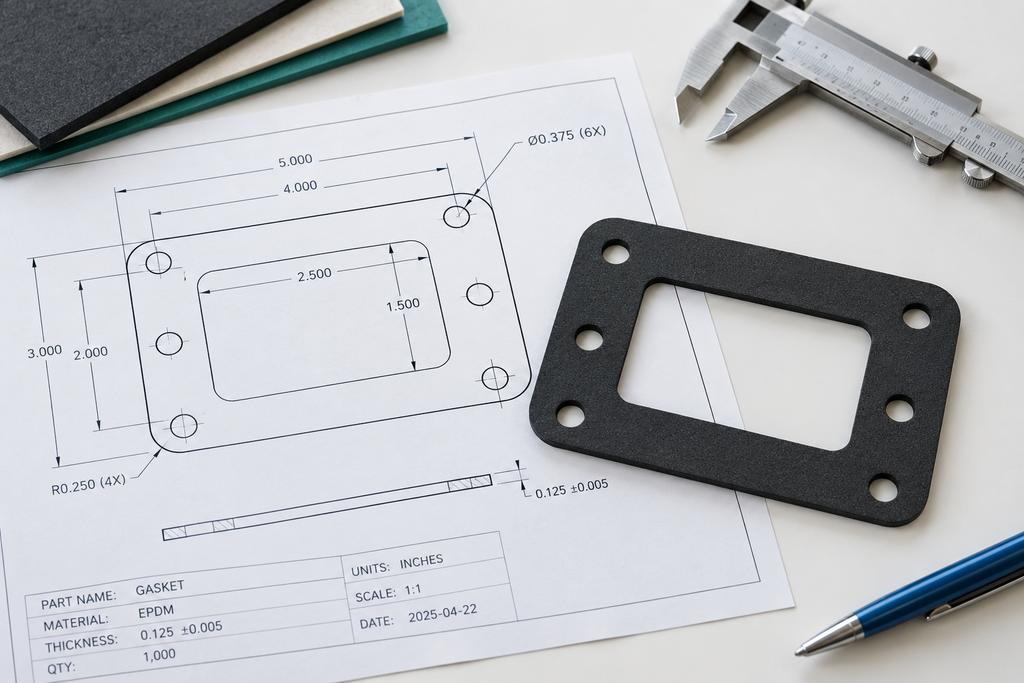
The single most useful thing you can provide with a quote request is a drawing of the part.
A good drawing should show the finished part geometry and identify the dimensions that matter.
Useful drawing information includes:
- Overall length and width
- Hole sizes
- Slot dimensions
- Cutouts
- Radii
- Material thickness
- Critical dimensions
- Required tolerances
- Material specification
- Adhesive requirements
- Any special notes
If you have a CAD file, send it along with the drawing.
Mag-Knight’s Quotation page currently accepts PDF, DXF, AI, JPG, and DWG drawing formats.
What if I don’t have a CAD drawing?
Don’t let that stop you from requesting a quote.
Depending on the part, you may be able to provide:
- A PDF drawing
- A physical sample
- A sketch
- A photograph
- An existing part
- An older drawing
- A DXF or other CAD file
If you only have a physical sample, tell us that when you request the quote.
2. Tell Us What Material You Need
Material selection can have a major effect on both the manufacturing process and the cost of a die-cut part.
Common die-cut materials include:
- Rubber
- EPDM
- Neoprene
- Silicone
- Buna-N / nitrile
- Viton® / FKM
- Foam
- EVA
- Polyurethane
- Polycarbonate
- Polyester
- PVC
- PTFE
- Cork
- Felt
- Fiberglass
- Fabrics
- Adhesive-backed materials
- Gasket materials
- Plastic films
- Magnetic materials
- Other flexible or sheet materials
If you know the exact material specification, provide it.
For example:
EPDM, 60 durometer, 0.062-inch thick
is much more useful for quoting than:
Rubber gasket
If you don’t know the material, that’s okay too.
Tell us what the part needs to do.
For example:
“I need a gasket that will be exposed to oil and elevated temperatures.”
Or:
“I need a soft foam pad to provide vibration isolation.”
Or:
“I need a thin plastic insulator.”
Those application requirements can help determine which materials should be considered.
See the Mag-Knight Materials Guide for a more complete list of materials and applications.
3. Specify the Material Thickness
Material thickness is especially important for die-cutting quotes.
Two parts with identical geometry can have very different manufacturing requirements if one is made from 0.020-inch material and the other is made from 0.250-inch material.
Include:
Material: Silicone
Thickness: 0.062 inch
If the thickness has a required tolerance, include that as well.
For example:
0.062 ± 0.005 inch
If you’re unsure what thickness is appropriate, tell us what the part does and what the application requires.
Material thickness can affect:
- Tooling
- Cutting force
- Feature size
- Part tolerances
- Edge quality
- Production method
- Material handling
- Overall cost
4. Tell Us How Many Parts You Need
Quantity is one of the most important pieces of information for a die-cutting quote.
A quote for:
10 pieces
can be very different from a quote for:
10,000 pieces
or:
1,000,000 pieces per year
The quantity helps determine the most appropriate manufacturing process and how tooling costs should be distributed across the production run.
If possible, provide:
- Prototype quantity
- Initial order quantity
- Expected annual quantity
- Expected lifetime quantity
You don’t need to know the exact future quantity.
An estimate such as:
“We need 500 initially and expect approximately 5,000 per year.”
is very helpful.
How Quantity Can Affect the Economics of Die Cutting
The chart below illustrates the general relationship between production quantity and the impact of one-time tooling costs.
This is why the expected production quantity is important when comparing die cutting with other manufacturing processes.
A one-time tooling cost becomes a much smaller cost per part as the number of parts increases.
For more information, see What Does Die Cutting Cost? and the Mag-Knight Pricing page.
5. Tell Us What Tolerances You Need
Not every dimension on a die-cut part needs the same tolerance.
If a dimension is critical to the function of your part, identify it on the drawing.
For example:
Critical hole diameter: 0.250 ± 0.005 inch
This tells the manufacturer that the hole is functionally important.
On the other hand, specifying an extremely tight tolerance on every dimension may unnecessarily increase manufacturing difficulty and cost.
A better approach is to identify the dimensions that actually matter to the function of the part.
When requesting a quote, tell us:
- Which dimensions are critical
- Which dimensions are approximate
- Any overall tolerance requirements
- Any special inspection requirements
If you’re designing a new part, see our guide:
How Do I Design a Part for Die Cutting?
6. Explain What the Part Does
This is one of the most overlooked pieces of information on an RFQ.
Don’t just tell us:
“I need a 0.125-inch rubber part.”
Tell us:
“I need a gasket that seals an enclosure exposed to outdoor temperatures and moisture.”
The second description gives the manufacturer much more useful information.
The application can help determine:
- Material selection
- Material hardness
- Thickness
- Adhesive requirements
- Manufacturing process
- Required tolerances
- Environmental requirements
Important application information can include:
Temperature
What temperatures will the part experience?
Chemical exposure
Will it contact oil, fuel, water, solvents, cleaning chemicals, or other substances?
Pressure
Does the part need to seal against pressure or vacuum?
Compression
Does the part need to compress and recover?
Electrical requirements
Does it need to provide insulation or other electrical properties?
Environmental exposure
Will it be exposed to sunlight, moisture, ozone, outdoor conditions, abrasion, or vibration?
If you don’t know what material to specify, the application information may allow us to help narrow down the choices.
7. Tell Us About Adhesives and Liners
If your part has adhesive, include that information with the RFQ.
For example:
Face material: Polycarbonate
Thickness: 0.010 inch
Adhesive: Pressure-sensitive adhesive
Liner: Release liner
Adhesive-backed components can require different processing depending on the construction of the material.
Tell us whether you need:
- Single-sided adhesive
- Double-sided adhesive
- Transfer adhesive
- Adhesive-backed foam
- Adhesive-backed rubber
- Adhesive-backed film
- Kiss cutting
- Through cutting
- Parts supplied on a liner
If you’re not sure whether the part should be kiss cut or through cut, explain how the parts will be supplied and installed.
8. Tell Us Whether This Is a Prototype or Production Part
Are you designing a new part?
Is the design already finalized?
Are you replacing an existing supplier?
Are you looking for a production source?
This information matters because the best process for a prototype may not be the same process used for long-term production.
For example, laser cutting can be useful for prototypes and design validation because it doesn’t require a dedicated die.
Once the design is finalized and production quantities increase, conventional die cutting may become more economical.
Mag-Knight offers both custom die cutting and laser cutting, allowing the manufacturing method to be considered based on your actual requirements.
If you’re developing a new part, you can also review our Rapid Prototyping information.
What If I Don’t Know Which Manufacturing Process I Need?
You don’t necessarily need to know whether your part should be die cut, laser cut, or produced using another process before you request a quote.
That’s part of the engineering evaluation.
For example, the same basic part could potentially be produced using:
- Steel-rule die cutting
- Rotary die cutting
- Laser cutting
- CNC cutting
- Other processes depending on the material and geometry
The best option depends on factors such as:
- Material
- Thickness
- Part geometry
- Tolerances
- Quantity
- Tooling cost
- Production speed
- Application requirements
See our comparison:
Laser Cutting vs. Die Cutting: Which Is Right for Your Part?
What If I Don’t Know Which Material I Need?
This is also common.
You may know exactly what the part needs to do without knowing the name of the material.
For example:
“I need a gasket for an outdoor electrical enclosure.”
or:
“I need a compressible pad that will isolate vibration.”
or:
“I need a thin, flexible insulating component.”
That information can help narrow down suitable materials.
Start with the Suitable Materials page, or include your application requirements when you submit your quotation request.
What About Gaskets and Seals?
Gaskets are one of the most common applications for custom die cutting.
If you’re requesting a gasket quote, include:
- Gasket material
- Thickness
- Inside and outside dimensions
- Bolt-hole locations
- Hole diameters
- Required compression
- Operating temperature
- Fluid or chemical exposure
- Pressure requirements
- Quantity
- Drawing or sample
If you don’t know which gasket material is appropriate, explain what the gasket needs to seal and what environment it will operate in.
See Custom Die-Cut Gaskets for additional information.
What If I Have a Physical Sample Instead of a Drawing?
A physical sample can still be useful.
If you have an existing part but no CAD drawing, tell us that when requesting a quote.
Depending on the part, a sample can provide information about:
- Overall shape
- Hole locations
- Feature geometry
- Material
- Thickness
- General construction
If possible, provide any information you have about the original material and application.
You can also photograph the sample and include the photographs with your RFQ.
engineering drawing and custom die-cut part for die cutting quote
A Simple Die-Cutting RFQ Checklist
Before submitting your request, check the following:
Part
☐ Part number
☐ Drawing or CAD file
☐ Overall dimensions
☐ Critical features
☐ Hole and slot dimensions
☐ Required tolerances
Material
☐ Material name/specification
☐ Thickness
☐ Hardness/durometer if applicable
☐ Adhesive specification if applicable
☐ Liner specification if applicable
Application
☐ What does the part do?
☐ Temperature range
☐ Chemical exposure
☐ Compression requirements
☐ Environmental exposure
☐ Electrical requirements if applicable
Production
☐ Prototype quantity
☐ Initial order quantity
☐ Expected annual quantity
☐ Production or prototype
☐ Desired delivery date
Special Requirements
☐ Inspection requirements
☐ Packaging requirements
☐ Individual parts or sheets
☐ Kiss cut or through cut
☐ Special certifications or material requirements
You don’t need every box checked before contacting Mag-Knight. If you’re missing information, simply tell us what you know and what you don’t know.
What File Types Can I Send for a Die-Cutting Quote?
Mag-Knight’s Quotation page currently lists these drawing formats:
- DXF
- AI
- JPG
- DWG
A CAD file is especially helpful when the geometry needs to be transferred into tooling.
If you have another format, don’t assume we can’t work with it. Tell us what you have.
How Does the Quote Process Work?
A typical custom die-cutting quote follows a simple process:
1. You send us your part information
Drawing, material, thickness, quantity, application, and any special requirements.
↓
2. We review the part
We evaluate the geometry, material, tolerances, quantity, and manufacturing requirements.
↓
3. We determine the appropriate process
Depending on the job, this could involve die cutting, laser cutting, or another appropriate method.
↓
4. We determine tooling requirements
If a die is required, the tooling cost is included separately from production pricing.
↓
5. We calculate production pricing
Material, press time, quantity, and other job-specific factors are considered.
↓
6. You receive the quotation
The quote provides the information you need to decide how to proceed.
For a current quote, go directly to the Mag-Knight Quotation page.
Don’t Know What You Need? Send What You Have.
One of the biggest mistakes customers make is waiting until they have a “perfect” RFQ before contacting a manufacturer.
You don’t necessarily need to know:
- The exact material
- The exact die type
- The best cutting process
- The exact tooling
- Every manufacturing specification
If you have a drawing and know what the part needs to accomplish, that’s a good place to start.
If you have a sample but no drawing, send information about the sample.
If you know the material but aren’t sure about the process, tell us what you’re trying to accomplish.
The purpose of the engineering review is to help determine the most practical way to manufacture the part.
Frequently Asked Questions About Die-Cutting Quotes
What information do I need to get a die-cutting quote?
At minimum, provide the part drawing or sample, material if known, material thickness, quantity, and intended application. Tolerances, adhesive requirements, and special requirements are also helpful.
Do I need a CAD drawing to get a die-cutting quote?
No. A CAD drawing is helpful, but you may also be able to request a quote using a PDF, JPG, physical sample, sketch, or other information. Mag-Knight currently lists PDF, DXF, AI, JPG, and DWG as accepted drawing formats.
What file types does Mag-Knight accept?
The Mag-Knight Quotation page currently lists PDF, DXF, AI, JPG, and DWG drawing formats.
How many parts do I need to order?
There is no single quantity that makes sense for every project. Mag-Knight handles both prototype and production requirements. Providing your expected quantity allows the appropriate manufacturing process and tooling economics to be evaluated.
Does the material affect the die-cutting price?
Yes. Material type, thickness, hardness, availability, and construction can all affect the manufacturing process and cost.
What if I don’t know what material to use?
Tell us what the part needs to do. Temperature, chemicals, compression, flexibility, electrical requirements, and environmental conditions can help determine suitable materials.
You can also review the Mag-Knight Materials Guide.
What if I don’t know whether my part should be die cut or laser cut?
That’s okay. Material, geometry, quantity, tolerances, and tooling economics all affect the decision. Mag-Knight offers both die cutting and laser cutting and can evaluate the appropriate process for your application.
Can you quote a gasket from a sample?
A physical sample can be useful when a drawing isn’t available. Provide as much information as possible about the material, thickness, application, and quantity.
Should I provide my annual quantity?
Yes, if you know it. Annual usage can be particularly helpful when evaluating tooling and production economics.
Do I need to specify every tolerance?
No. Identify the dimensions that are functionally critical. Applying extremely tight tolerances to every dimension can make a part unnecessarily difficult or expensive to manufacture.
How quickly can I get a quote?
Mag-Knight’s website currently advertises a fast quote process, and the quotation page is the best place to submit the drawing and project information for evaluation.
Ready to Request a Die-Cutting Quote?
The easiest way to get started is to send us what you have.
If you have a complete drawing, include it.
If you have a CAD file, include it.
If you have a physical sample, tell us.
If you’re unsure about the material or manufacturing process, explain what the part needs to do.
We’ll use that information to evaluate the material, tooling, manufacturing process, and production requirements.
