

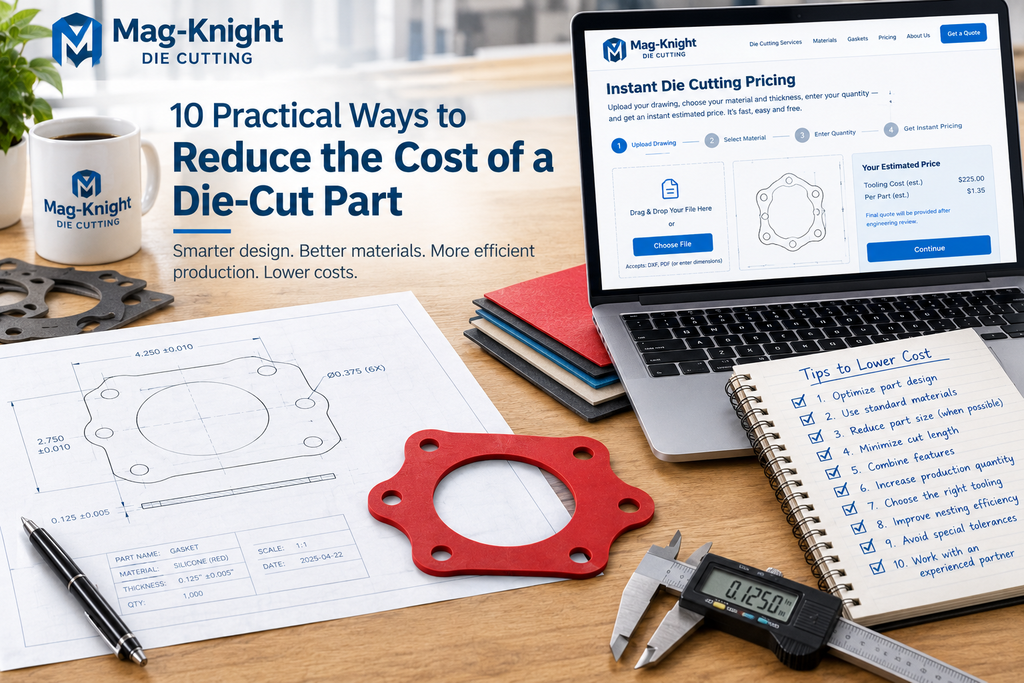
The fastest ways to lower the cost of a die-cut part are to order larger quantities, loosen tolerances where function allows, choose a similar but less expensive material, simplify the part so it cuts more easily, and consolidate your orders under a standing yearly PO. Most parts can improve on two or three of these at once, and the savings stack. Below are the ten levers we see make the biggest difference at Mag-Knight, with the reasoning behind each so you can decide which fit your part.
1. Order Larger Quantities
Tooling and setup are fixed costs, so the more parts you spread them across, the less each part carries. A $200 die spread across 100 parts adds $2.00 to every part. Spread across 1,000 parts, it adds $0.20, and across 10,000 parts, $0.02. Press time works the same way, since a longer run keeps the press cutting continuously instead of stopping for changeovers. If you know your annual usage, ordering closer to that number in fewer releases is usually the single biggest price lever you have. See our cost breakdown for how die cost and production cost combine into a per-part price.
2. Loosen Tolerances Where Function Allows
Standard die-cutting tolerances are tighter than many parts actually need. When a drawing calls for tolerances tighter than standard, we may need to perform SPC (statistical process control), which means measuring parts during the run and charting the results. That inspection time is real cost. If a dimension doesn’t affect fit or function, loosen it, and apply tight tolerances only to the features that truly need them. Our engineering library has more on which tolerances are realistic for different materials.
3. Choose a Similar but Less Expensive Material
Material is often the largest line item on a part, and many applications are specified with a more expensive material than the job requires. If your gasket sees moderate temperatures and light compression, a lower-cost rubber or foam grade may perform identically to the premium one on your drawing. Check the temperature, chemical, and compression requirements, then compare alternatives. The instant pricing tool makes this easy, since you can price the same part in several materials in seconds and see the difference side by side. Our suitable materials page lists what we regularly run.
4. Make the Part Easier to Cut
Parts with less detail cost less to tool and run. A few design habits make a real difference:
- Keep holes away from edges. Holes placed too close to an edge are hard to cut cleanly and can distort the part. Give them room.
- Avoid closely spaced parallel lines. Narrow webs between cut lines are fragile in both the die and the part.
- Respect bend radius limits. Softer materials cut with thin rule can hold a bend radius around 1/16″, while harder materials need thicker rule with a minimum radius of 3/32″. Designing to these limits avoids a die that is expensive to build or wears faster.
- Reduce unnecessary detail. Every extra feature adds bending, setup, and potential for scrap.
The instant pricing tool flags hard-to-cut features right on your drawing, so you can fix them before requesting a quote.
5. Place a Standing Yearly PO
If you use the same part throughout the year, a standing PO that you fulfill with scheduled releases lets us plan material purchases and press time around your demand instead of treating each order as a one-off. You get the volume benefit of a larger commitment without taking delivery of everything at once. Ask us about structuring one through our quotation page.
6. Standardize on Stocked Materials and Thicknesses
Materials we run regularly are easier to source and cut than specialty items. Where your design has flexibility, choosing a common thickness and material grade over an unusual one can reduce both material cost and lead time.
7. Use Material Efficiently
How parts sit on a sheet affects how much material is scrap. Simple, compact shapes nest well, and slight changes to a part’s outline can sometimes allow noticeably better yield. If you’re flexible on a dimension, ask whether adjusting it would improve material utilization.
8. Consolidate Similar Parts
If you order several parts that are close variants of each other, ask whether one design could serve more than one application, or whether related parts could share a die layout. Fewer unique parts means fewer dies and fewer setups.
9. Keep Your Existing Die and Avoid Revisions
When Mag-Knight builds your die, you own it and we store it in-house for future orders, so reorders don’t carry tooling cost again. Design changes after the die is built can mean modifying or replacing it, so finalize the design before tooling. If the design may still change, rapid prototyping with laser cutting lets you validate the part first. Our laser vs. die cutting comparison explains when each process makes sense.
10. Supply Your Own Material
If you already buy material at a better price, or have inventory on hand, you can supply it. Tell us when you request pricing and we’ll build the estimate around your material.
Cost Levers at a Glance
| Lever | What to Change | Typical Impact |
|---|---|---|
| Quantity | Order more per release, or consolidate releases | High |
| Standing yearly PO | Commit annual volume with scheduled releases | High |
| Material choice | Switch to a similar, lower-cost material | High |
| Tolerances | Loosen where function allows, avoiding SPC | Medium to High |
| Part geometry | Fewer details, holes off edges, no tight parallel lines | Medium |
| Customer-supplied material | Provide your own stock | Medium |
| Material yield | Adjust shape or size for better nesting | Low to Medium |
| Part consolidation | Fewer unique parts and dies | Low to Medium |
Impact is general guidance. The size of the savings depends on your part, material, and volume.
See the Difference Before You Commit
The easiest way to test these ideas is to price your part more than once. Upload your drawing to the instant pricing tool, then change one variable at a time, such as material or quantity, and watch the estimate move. When you’re ready for a firm number, request a quotation and our engineers will review the part and suggest further savings, from custom die cutting design tweaks to gasket material swaps.
Frequently Asked Questions
What is the biggest factor in die-cut part cost? For most parts it’s quantity and material. Larger quantities spread fixed tooling and setup across more parts, and material is often the largest direct cost on the part.
Does loosening tolerances really lower the price? Yes. Tolerances tighter than standard can require SPC (statistical process control) inspection during the run, which adds time and cost. Loosening tolerances on non-critical dimensions avoids that.
How can I lower cost without changing the material? Increase quantity, simplify the part geometry, keep holes away from edges, avoid closely spaced parallel lines, and consider a standing yearly PO with scheduled releases.
What is a standing yearly PO? It’s a purchase order covering your expected annual usage that you fulfill with scheduled releases throughout the year. It gives you volume pricing benefits without taking delivery of everything at once.
Why do holes near the edge increase cost? Holes placed too close to an edge are harder to cut cleanly and can distort the part, which increases scrap and die wear. Moving them inward makes the part easier and cheaper to cut.
Can I supply my own material to save money? Yes. If you have a better source or existing inventory, tell us when you request pricing and we’ll build the estimate around it.
How do I see how a design change affects price? Use the free instant pricing tool. Upload your drawing, change the material or quantity, and compare estimates immediately.
Want help trimming cost on a specific part? Request a quote with your drawing, or reach out through our contact page and our engineering team will suggest where to save.
