

The Short Answer
A die-cut gasket is a flat seal cut from sheet rubber, fiber, PTFE, cork or foam with a steel rule die. At Mag-Knight we hold key features to ±0.005″, charge no setup fees, start at 5 pieces, and a simple letter-size die costs about $200.
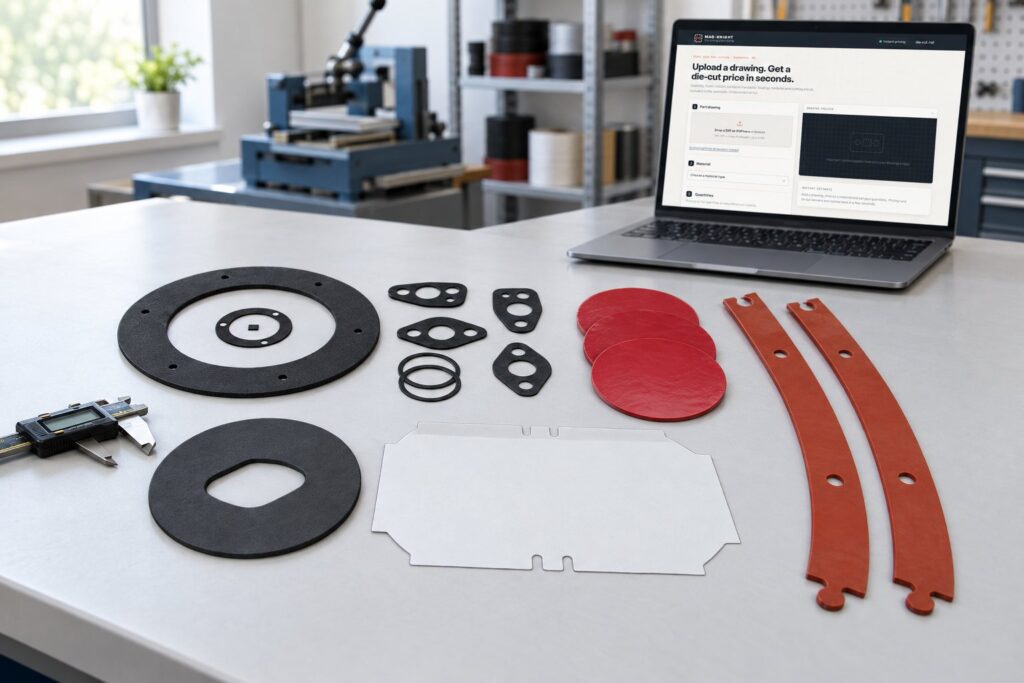
Want a price right now? Our new Instant Gasket Pricing tool is free. Upload a DXF or PDF, pick from 418 gasket materials, and get per-part and tooling prices in seconds. No waiting days for a quote, and no sales call.
This guide covers how die-cut gaskets are made, which materials we stock, the tolerances you can expect, what they cost (with real numbers from our estimator), and how to design a gasket that cuts cleanly the first time.
What Is a Die-Cut Gasket?
A die-cut gasket is cut from flat sheet stock using a steel rule die: a thin, sharpened steel blade bent to the outline of your part and set into a laser-cut board. A flatbed hydraulic press pushes the die through the material and cuts the outside shape, bolt holes and inner openings in a single stroke.
Because the die cuts every feature at once, every gasket in the run comes out the same. The die is a one-time cost and is reused for every reorder. Our press handles parts up to 30″ × 60″. For small gaskets we build dies with up to 7 cavities, so one press stroke cuts several parts.
Gasket Materials We Cut
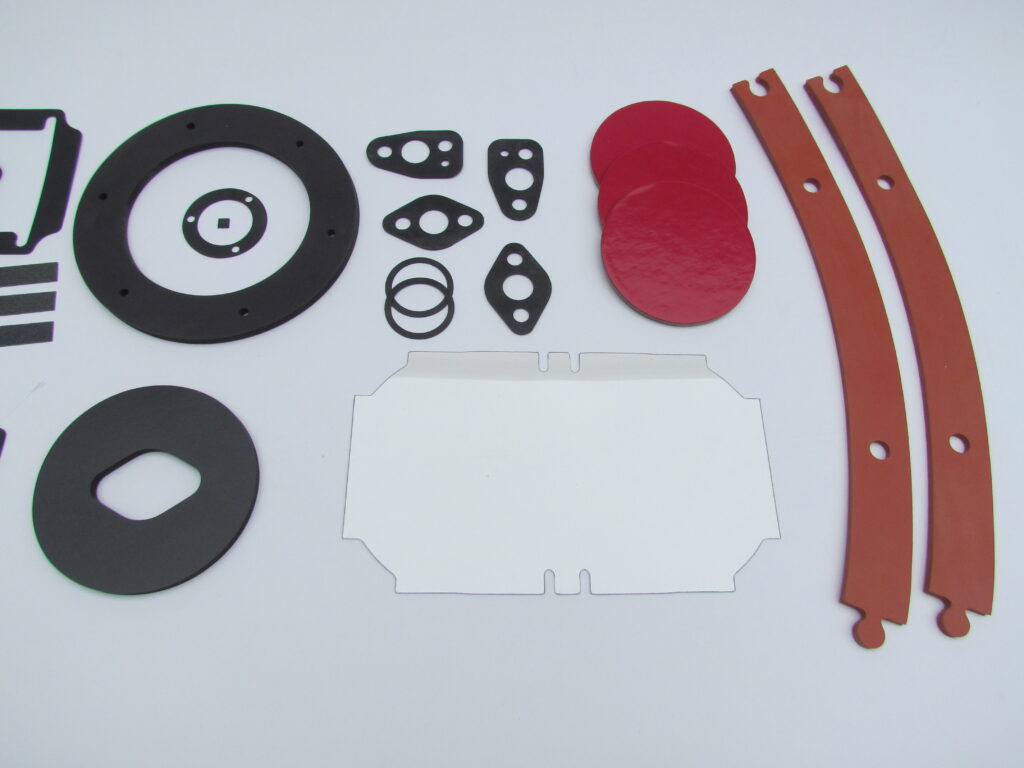
Our Instant Gasket Pricing tool lists 418 gasket material and thickness combinations, and we can cut almost any other flat sheet you supply. These are the main families:
| Material family | Examples we stock | Typical use |
|---|---|---|
| Solid rubber | Neoprene, nitrile (Buna-N), EPDM, Viton® (FKM), SBR, butyl, pure gum, Santoprene™; 40–75 durometer | Water, oil, weather and general sealing |
| Silicone rubber | Red silicone 40–70 durometer, white FDA silicone, fiberglass-reinforced silicone | High and low temperature, food contact |
| Compressed fiber | Garlock Blue-Gard® 3000/3200/3300/3700, Klingersil® C-4401, Teadit® NA1001, 750G non-asbestos | Pipe flanges, pumps, oil, water and steam |
| PTFE | Garlock Gylon® 3500/3504/3510, Gore® GR, Teadit® TF1570 | Strong acids, solvents, aggressive chemicals |
| Cork and cork-rubber | Cork-nitrile, cork-neoprene, natural cork; PSA available | Oil covers and low bolt-load joints |
| Sponge and foam | Neoprene sponge, red silicone sponge, EPDM foam | Dust and weather seals, cushioning |
| Fuel-cell and high temperature | Ceramic felt | Sealing between fuel cells above 2000°F |
Not sure which one fits? Read our gasket material selection guide. It compares temperature ranges, chemical resistance and cost side by side.
Die-Cut Gasket Tolerances
| Feature | Mag-Knight tolerance |
|---|---|
| Key features (bolt holes, sealing edges, hole-to-hole spacing) | ±0.005″ |
| General features (outside perimeter, non-critical cutouts) | ±0.015″ |
| Unspecified dimensions | ±0.032″ |
| Material thickness | Per the sheet manufacturer’s specification |
Rubber and sponge compress under the cutting rule and then spring back, so soft gaskets are measured in their free (uncompressed) state. Firmer materials such as compressed fiber, PTFE and 70-durometer rubber hold dimensions most consistently. See our die cutting tolerance guide for more detail.
What Does a Die-Cut Gasket Cost?
We ran a typical part through our free instant estimator: a 3″ × 3″ neoprene gasket, 1/16″ thick, 60 durometer, with four 1/4″ bolt holes. Material, cutting and the steel rule die are all included in these numbers.
| Quantity | Price per gasket | One-time steel rule die |
|---|---|---|
| 25 | $9.30–$12.50 | $170–$230 |
| 100 | $3.20–$4.35 | $200–$270 |
| 500 | $1.75–$2.35 | $230–$300 |
| 1,000 | $1.35–$1.85 | $250–$340 |
Two things stand out. First, the per-part price falls fast: from about $11 each at 25 pieces to under $2 at 1,000. Second, the die costs a little more at higher quantities because we build it with more cavities so each press stroke cuts more gaskets. That is what brings the per-part price down. Reorders reuse the same die, so you pay for tooling once.
Material choice matters too. The same gasket at 500 pieces runs about $1.50–$2.05 each in red SBR, $4.40–$5.95 in Viton® and $13.00–$17.50 in Gylon® PTFE. The material selection guide has the full cost comparison.
Get a Free Instant Gasket Price in Seconds
Most gasket shops make you wait two or three days for a quote. Ours takes seconds, and it is free:
- Upload your drawing. DXF or PDF, up to 8 MB. No drawing? Enter the outside dimensions, hole count and hole size instead.
- Pick your material. Choose from 418 gasket materials and thicknesses, or tell us you are supplying your own.
- Enter up to four quantities. The minimum is 5 pieces.
- Get your instant price. Enter your name and email, and per-part and tooling prices appear in seconds. Features that would be hard to cut, such as a hole too close to an edge, are flagged on your drawing.

Every estimate is nonbinding. When you are ready to order, I review your drawing personally, at no charge, before we build the die. Most gasket orders ship in about 2 weeks with new tooling and about 7 days on repeat orders.
Gasket Design Tips That Save Money
- Hole-to-edge distance: keep at least 1× the hole diameter of material between a bolt hole (5/8″ or smaller) and the gasket edge. For holes over 5/8″, keep at least 0.30″.
- Web between holes: leave at least 1× the material thickness between any two cut lines, or the narrow strip can tear.
- Inside corners: use a radius of at least 1/16″ in soft materials and 3/32″ in hard ones.
- Small features: holes, slots or tabs under 1/4″, and more than 10 cutouts, add cost. Use them only where the seal needs them.
- Thickness: 1/16″ and 1/8″ are the most common and least expensive gasket thicknesses.
- Prototypes first: for prototypes and short runs, we can laser cut gaskets with no die at all. See when a die pays for itself.
All of our design limits are in the die-cut design rules.
Frequently Asked Questions
What is a die-cut gasket?
A die-cut gasket is a flat seal cut from sheet rubber, compressed fiber, PTFE, cork or foam with a steel rule die in a press. The die cuts the outside shape and every hole in one stroke, so every part is identical.
How much does a custom die-cut gasket cost?
For a 3 inch square, 1/16 inch neoprene gasket with four bolt holes, our free instant estimator shows about $3.20–$4.35 each at 100 pieces and $1.35–$1.85 each at 1,000 pieces, plus a one-time steel rule die of about $200–$340. Price depends on size, material and quantity.
Is there a free gasket price estimator?
Yes. Mag-Knight’s Instant Gasket Pricing tool is free. Upload a DXF or PDF drawing, choose from 418 gasket materials, enter quantities and get per-part and tooling prices in seconds.
What is the minimum order for die-cut gaskets?
Mag-Knight’s minimum order is 5 pieces, with no setup fees.
What tolerances can die-cut gaskets hold?
Mag-Knight holds key features such as bolt holes and sealing edges to ±0.005 inch, general features to ±0.015 inch and unspecified dimensions to ±0.032 inch. Soft rubber and sponge are measured in their free state.
How long does it take to get die-cut gaskets?
About 2 weeks for a new order that needs a steel rule die, and about 7 days for repeat orders that reuse the existing die.
Should I laser cut or die cut my gaskets?
Laser cutting needs no tooling and is usually cheaper for prototypes and small runs. Above a few hundred to a couple thousand parts, a steel rule die usually pays for itself. Mag-Knight does both.

Pingback: Gasket Material Selection Chart: Neoprene, Nitrile, EPDM, Silicone, Viton | Mag-Knight