

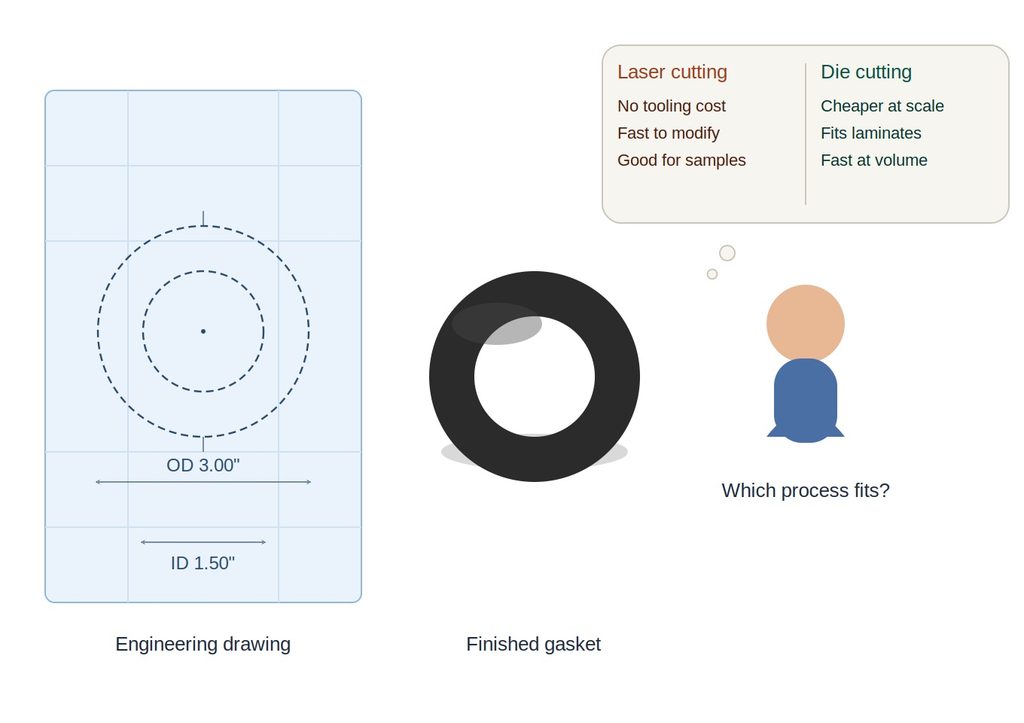
For most parts, the break-even point between laser cutting and die cutting lands somewhere between a few hundred and a couple thousand parts, though the exact number depends on your part’s size, material, and geometry. Below that volume, laser cutting is usually cheaper overall since it carries no tooling cost. Above it, a die pays for itself and starts saving money on every additional part. Here’s how to estimate where that line falls for your project, using how Mag-Knight, which runs both processes in-house, actually walks customers through the decision.
The Break-Even Formula
The math is simpler than it looks:
Break-even quantity = Die cost ÷ (Laser cost per part − Die cost per part)
Die cutting has an upfront tooling cost but a lower cost per part once running. Laser cutting has no tooling cost but a higher cost per part, since every part is cut individually rather than stamped through a fixed die. The break-even quantity is simply the point where the die’s upfront cost has been fully offset by the per-part savings.
A Worked Example
Say a part costs $225 to tool as a die (typical for a moderately complex steel rule die, see our custom die cost breakdown for how that number is built). Laser cutting that same part might run around $0.75 each in cut time, while die cutting it, once tooled, runs closer to $0.10 each in press time. The per-part savings is $0.65.
$225 ÷ $0.65 ≈ 346 parts
Below roughly 346 parts, laser cutting is the cheaper total cost. Above it, the die has paid for itself and every additional part costs less than it would have on the laser.
| Quantity | Laser Cutting Total | Die Cutting Total (incl. $225 tooling) | Cheaper Option |
|---|---|---|---|
| 50 | $37.50 | $230.00 | Laser |
| 100 | $75.00 | $235.00 | Laser |
| 346 | $259.50 | $259.60 | Break-even |
| 500 | $375.00 | $275.00 | Die |
| 1,000 | $750.00 | $325.00 | Die |
| 5,000 | $3,750.00 | $725.00 | Die |
These figures are illustrative, built around typical per-part costs for a mid-complexity part. Your actual break-even point depends on your part’s size, material hardness, and feature count, which affect both the die price and the per-part cutting time on either process. For real numbers, request a quotation and we’ll run this calculation against your actual drawing.
What Shifts the Break-Even Point
A few factors move that 346-part example up or down:
- Material hardness. Harder materials cost more to tool (thicker rule) but often see a bigger per-part time savings on die versus laser, which can lower the break-even quantity. See our suitable materials page for what we stock.
- Part complexity. More intricate geometries tend to slow laser cutting down more than they slow die cutting down, since a die cuts the whole shape in one stroke regardless of detail. Complex parts often reach break-even sooner than simple ones.
- Multi-layer laminates. Parts with bonded layers, like gaskets, are usually die-cut candidates well before the break-even math alone would suggest, since die cutting handles laminates more cleanly than a laser can.
- Metal and foil layers. For foil-backed or metal cutting components, tolerance requirements can push the decision in either direction independent of pure cost.
You Don’t Have to Decide Up Front
This is where running both processes under one roof matters. Most projects don’t start by committing to a volume, they start with a design that isn’t locked yet. The practical path is to prototype and validate the part with rapid prototyping laser cutting first, since there’s no tooling cost while the design might still change. Once the design is finalized and your order volume is clear, Mag-Knight can run the break-even math against your real numbers and tell you whether tooling a die makes sense yet, or whether you’re better off staying on laser a while longer.
Because the die, once built, uses the same material spec as the laser-cut prototypes, the transition doesn’t introduce new variables to validate. And since Mag-Knight stores customer-owned dies in-house at no charge, there’s no added cost or delay to having a die ready and waiting once volume crosses the line. See our custom die cutting and custom laser cutting pages for how both sides of that transition work.
Frequently Asked Questions
What’s a typical break-even quantity between laser and die cutting? It varies by part, but a few hundred to a couple thousand parts is typical. Larger, simpler parts and harder materials often break even sooner; small, high-precision parts can take longer.
Can I start with laser cutting and switch to die cutting later? Yes, and this is the most common path. Prototyping or early production on laser cutting lets you validate the design before paying for tooling, then transitioning to a die once volume justifies it.
Does Mag-Knight calculate the break-even point for my specific part? Yes. Send a drawing and expected volume through our quotation page and our engineering team will run the actual numbers rather than relying on a general estimate.
Does material choice affect the break-even point? Yes, significantly. Harder materials cost more to tool but often see a larger per-part time savings from die cutting, which can shift the break-even point lower than it would be for a softer material.
Is there a minimum order size to get a die made? No. You can tool a die for a single order if you choose, but the economics generally favor waiting until your volume approaches the break-even point unless there’s a reason, like tolerance or laminate construction, to prefer die cutting regardless of quantity.
What if my volume is right around the break-even point? That’s exactly when it’s worth getting an actual quote on both. At the margin, small differences in part geometry or material can tip the decision either way, so real numbers beat estimation.
Not sure where your part lands? Request a quote with your drawing and expected volume, and we’ll run the break-even numbers for you. Our engineering library also has more detail on process selection if you want to dig in before reaching out through our contact page.
