How Many Parts Do I Need Before Die Cutting Is Cost Effective?


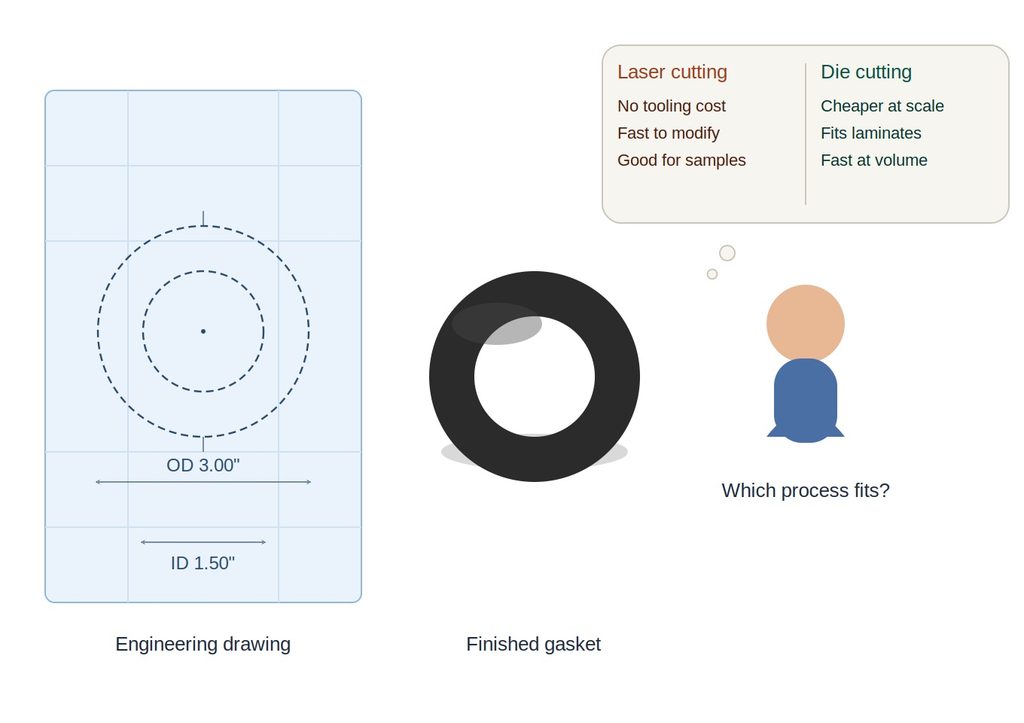
For most parts, the break-even point between laser cutting and die cutting lands somewhere between a few hundred and a couple thousand parts, though the exact number depends on your part’s size, material, and geometry. Below that volume, laser cutting is usually cheaper overall since it carries no tooling cost. Above it, a die pays for itself and starts saving money on every additional part. Here’s how to estimate where that line falls for your project, using how Mag-Knight, which runs both processes in-house, actually walks customers through the decision.

The Break-Even Formula

The math is simpler than it looks:

Break-even quantity = Die cost ÷ (Laser cost per part − Die cost per part)

Die cutting has an upfront tooling cost but a lower cost per part once running. Laser cutting has no tooling cost but a higher cost per part, since every part is cut individually rather than stamped through a fixed die. The break-even quantity is simply the point where the die’s upfront cost has been fully offset by the per-part savings.

A Worked Example

Say a part costs $225 to tool as a die (typical for a moderately complex steel rule die, see our custom die cost breakdown for how that number is built). Laser cutting that same part might run around $0.75 each in cut time, while die cutting it, once tooled, runs closer to $0.10 each in press time. The per-part savings is $0.65.

$225 ÷ $0.65 ≈ 346 parts

Below roughly 346 parts, laser cutting is the cheaper total cost. Above it, the die has paid for itself and every additional part costs less than it would have on the laser.

QuantityLaser Cutting TotalDie Cutting Total (incl. $225 tooling)Cheaper Option
50$37.50$230.00Laser
100$75.00$235.00Laser
346$259.50$259.60Break-even
500$375.00$275.00Die
1,000$750.00$325.00Die
5,000$3,750.00$725.00Die

These figures are illustrative, built around typical per-part costs for a mid-complexity part. Your actual break-even point depends on your part’s size, material hardness, and feature count, which affect both the die price and the per-part cutting time on either process. For real numbers, request a quotation and we’ll run this calculation against your actual drawing.

What Shifts the Break-Even Point

A few factors move that 346-part example up or down:

  • Material hardness. Harder materials cost more to tool (thicker rule) but often see a bigger per-part time savings on die versus laser, which can lower the break-even quantity. See our suitable materials page for what we stock.
  • Part complexity. More intricate geometries tend to slow laser cutting down more than they slow die cutting down, since a die cuts the whole shape in one stroke regardless of detail. Complex parts often reach break-even sooner than simple ones.
  • Multi-layer laminates. Parts with bonded layers, like gaskets, are usually die-cut candidates well before the break-even math alone would suggest, since die cutting handles laminates more cleanly than a laser can.
  • Metal and foil layers. For foil-backed or metal cutting components, tolerance requirements can push the decision in either direction independent of pure cost.

You Don’t Have to Decide Up Front

This is where running both processes under one roof matters. Most projects don’t start by committing to a volume, they start with a design that isn’t locked yet. The practical path is to prototype and validate the part with rapid prototyping laser cutting first, since there’s no tooling cost while the design might still change. Once the design is finalized and your order volume is clear, Mag-Knight can run the break-even math against your real numbers and tell you whether tooling a die makes sense yet, or whether you’re better off staying on laser a while longer.

Because the die, once built, uses the same material spec as the laser-cut prototypes, the transition doesn’t introduce new variables to validate. And since Mag-Knight stores customer-owned dies in-house at no charge, there’s no added cost or delay to having a die ready and waiting once volume crosses the line. See our custom die cutting and custom laser cutting pages for how both sides of that transition work.

Frequently Asked Questions

What’s a typical break-even quantity between laser and die cutting? It varies by part, but a few hundred to a couple thousand parts is typical. Larger, simpler parts and harder materials often break even sooner; small, high-precision parts can take longer.

Can I start with laser cutting and switch to die cutting later? Yes, and this is the most common path. Prototyping or early production on laser cutting lets you validate the design before paying for tooling, then transitioning to a die once volume justifies it.

Does Mag-Knight calculate the break-even point for my specific part? Yes. Send a drawing and expected volume through our quotation page and our engineering team will run the actual numbers rather than relying on a general estimate.

Does material choice affect the break-even point? Yes, significantly. Harder materials cost more to tool but often see a larger per-part time savings from die cutting, which can shift the break-even point lower than it would be for a softer material.

Is there a minimum order size to get a die made? No. You can tool a die for a single order if you choose, but the economics generally favor waiting until your volume approaches the break-even point unless there’s a reason, like tolerance or laminate construction, to prefer die cutting regardless of quantity.

What if my volume is right around the break-even point? That’s exactly when it’s worth getting an actual quote on both. At the margin, small differences in part geometry or material can tip the decision either way, so real numbers beat estimation.


Not sure where your part lands? Request a quote with your drawing and expected volume, and we’ll run the break-even numbers for you. Our engineering library also has more detail on process selection if you want to dig in before reaching out through our contact page.
Laser Cutting vs. Die Cutting: Which Is Right for Your Part?

The short answer: die cutting wins on cost per part at volume once tooling is paid off, while laser cutting wins on speed to first part and design flexibility since it needs no tooling at all. Which one is actually right for your part depends on your production volume, tolerance requirements, and how locked in your design is. Below is a practical breakdown of both processes. Because Mag-Knight runs both in-house, we can walk through the trade-offs without steering you toward whichever one we happen to offer.

What Is Die Cutting?

Part ready to be cut in a die cutting press
Part ready to be cut in a Die Cutting Press

Die cutting uses a shaped tool, typically a steel rule die or rotary die, pressed through material to cut, crease, or perforate it in a single stroke. Because the die itself is a fixed pattern, die cutting is fast per part once running, but requires a one-time tooling investment before the first part comes off the press. See custom die cutting for the full range of steel rule and rotary work we do.

  • Typical tolerance: ±0.005″ on key features and ±0.015″ on general features at Mag-Knight, depending on material and geometry
  • Typical tooling cost: $200–$250 for a standard steel rule die with moderate features (see our full cost breakdown for how that number is built)
  • Best fit: Medium-to-high volume runs, multi-layer laminates, gaskets, repeatable production parts

What Is Laser Cutting?

Laser cut silicone
Silicone Bulb Seal Being Laser Cut

Laser cutting uses a focused beam to cut material directly from a digital file, with no physical tool required. That makes it the default choice for prototypes, design iterations, and any part where the design might still change. Our custom laser cutting service runs the same materials as our die-cutting line, so switching between the two processes doesn’t mean switching vendors.

  • Typical tolerance: ±0.002″ to ±0.005″, generally tighter than mechanical die cutting on thin materials
  • Typical tooling cost: $0. Cost is driven entirely by cut time per part
  • Best fit: Prototypes, short runs, intricate or frequently-changing geometries, one-off or low-volume parts

Die Cutting vs. Laser Cutting at a Glance

FactorDie CuttingLaser Cutting
Tooling cost$200–$250 typical$0
Cost driverPress time (~$100/hr)Cut time per part
Tolerance±0.005″ key / ±0.015″ general±0.002″–0.005″
Speed at volumeVery fast once tooledSlower per part
Design changesRequires new/modified dieInstant, just update the file
Best volume rangeMedium to highPrototype to low volume
Multi-layer laminatesExcellentLimited (heat can affect adhesives)

When Die Cutting Wins

Die cutting is the better economic choice once your part design is locked and your volume is high enough to amortize the tooling cost. A $225 die spread across 5,000 parts adds pennies to each one, and rotary die cutting in particular can move through high volumes far faster than a laser can trace the same shape one part at a time. Die cutting is also the stronger choice for multi-layer laminates, such as foam-to-adhesive or fabric-to-foam, where a single die stroke cuts cleanly through bonded layers that a laser’s heat could distort or delaminate. If your part is a gasket or uses layered materials, this is usually where you land.

When Laser Cutting Wins

Laser cutting wins whenever the design isn’t final, the volume doesn’t justify tooling, or the geometry is intricate enough that die maintenance would be a headache. Because there’s no tooling to build, laser-cut parts can often ship faster on a first order than a tooled die-cut part, even though per-part cost is higher. It’s also the better fit for tight-tolerance features on thin films and foils, and for rapid prototyping runs where you need real parts in hand before committing to a hard die.

Cost Comparison: Where the Break-Even Point Is

Because die cutting carries an upfront tooling cost and laser cutting doesn’t, there’s a volume point where die cutting becomes cheaper overall. Roughly speaking: divide the die’s tooling cost by the per-part cost difference between the two processes to estimate your break-even quantity. For a typical $225 die and a modest per-part savings on press time, that break-even point often falls somewhere between a few hundred and a couple thousand parts, depending on part size and material. Below that volume, laser cutting is usually the cheaper total cost; above it, die cutting wins. See pricing for how we scope both.

Why It Doesn’t Have to Be an Either/Or

Because Mag-Knight runs both processes under one roof, the practical path for most projects is to prototype with laser cutting while the design is still moving, then transition to a die once the part is locked and volume justifies it, using the same material spec throughout so nothing changes except the process. Our engineering team reviews incoming drawings and recommends which process fits at each stage, rather than defaulting to whichever machine happens to be free. That review is included at no charge when you request a quotation.

If you’re weighing metal cutting options as part of this decision, the same logic applies. Thin foils and shim stock can go either way depending on tolerance and volume, so it’s worth getting a recommendation before committing to tooling either direction.

Frequently Asked Questions

Is laser cutting more accurate than die cutting? Not always. Laser cutting can hold ±0.002″–0.005″ on thin materials and fine detail, while Mag-Knight holds die-cut key features to ±0.005″ and general features to ±0.015″. Steel rule die cutting is also very repeatable at production volume, so the better choice depends on material, volume, and feature requirements.

Which is cheaper, laser cutting or die cutting? It depends on volume. Laser cutting has no tooling cost, so it’s usually cheaper for prototypes and short runs. Die cutting has an upfront tooling cost (typically $200–$250) but a lower cost per part at volume once that tooling is paid off.

Can the same part be laser cut first and die cut later? Yes, and this is a common path. Laser cutting is often used to prototype and validate a design before investing in a die, using the same material so the transition to production doesn’t introduce new variables.

Does laser cutting work on multi-layer or adhesive-backed materials? It can, but with more limitations than die cutting. Heat from the laser can affect adhesives or cause delamination on bonded layers, which is why die cutting is generally preferred for laminates and gasket constructions.

How do I know which process is right for my part? The fastest way is to send your drawing and expected volume through our quotation page. Since Mag-Knight runs both processes, our engineering team can recommend whichever fits your tolerance, material, and volume, without a bias toward one machine over the other.

What if my volume is somewhere in the middle? That’s exactly when it’s worth requesting numbers on both. If you’re between a few hundred and a couple thousand parts, the better process can genuinely go either way depending on part geometry and material, so getting an actual quote on both beats guessing.


Not sure which process fits your part? Request a quote or reach out through our contact page. We’ll recommend laser or die cutting based on your drawing, not on which machine we’d rather run. Our engineering library also has more reference material on tolerances and design-for-manufacturability if you want to dig in further.